

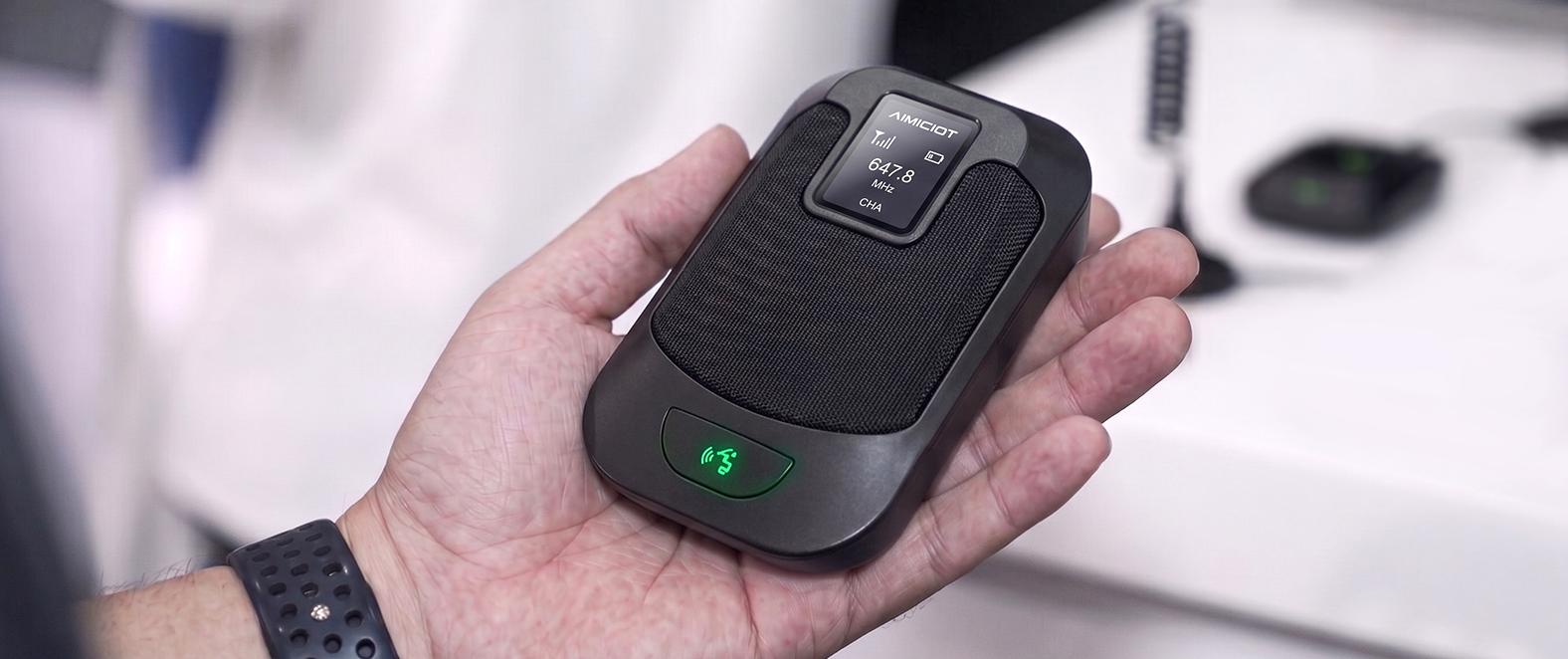
When planning or upgrading an audio video conference system, a frequently raised question is whether to adopt analog or digital technology. This point requires clarification: modern conference systems rarely rely solely on one technology. Instead, they integrate analog sound pickup, digital signal processing, network transmission, analog sound reinforcement and other modules simultaneously.
Digital technology delivers distinct advantages in signal processing, signal routing, centralized management and system scalability. Nevertheless, analog audio links have not been phased out. For scenarios with a small number of audio channels, simple functional requirements or pre-existing analog infrastructure, properly designed analog links remain reliable, straightforward and cost-effective.
Therefore, technology selection should not be determined merely by meeting room capacity or technical terminology. Instead, comprehensive factors must be evaluated: usage scenarios, room acoustics, microphone quantity, remote conferencing capabilities, cabling conditions, network and wireless environments, security requirements, future expansion plans, and total lifecycle costs.
II. What Are Analog and Digital Audio Links?
Sound exists in nature as sound waves. Microphones first convert changes in sound pressure into electrical signals. These signals can then be transmitted in analog form, or converted via analog-to-digital conversion for processing and transmission over digital links. A single conference system often incorporates both analog and digital signal paths at different stages.
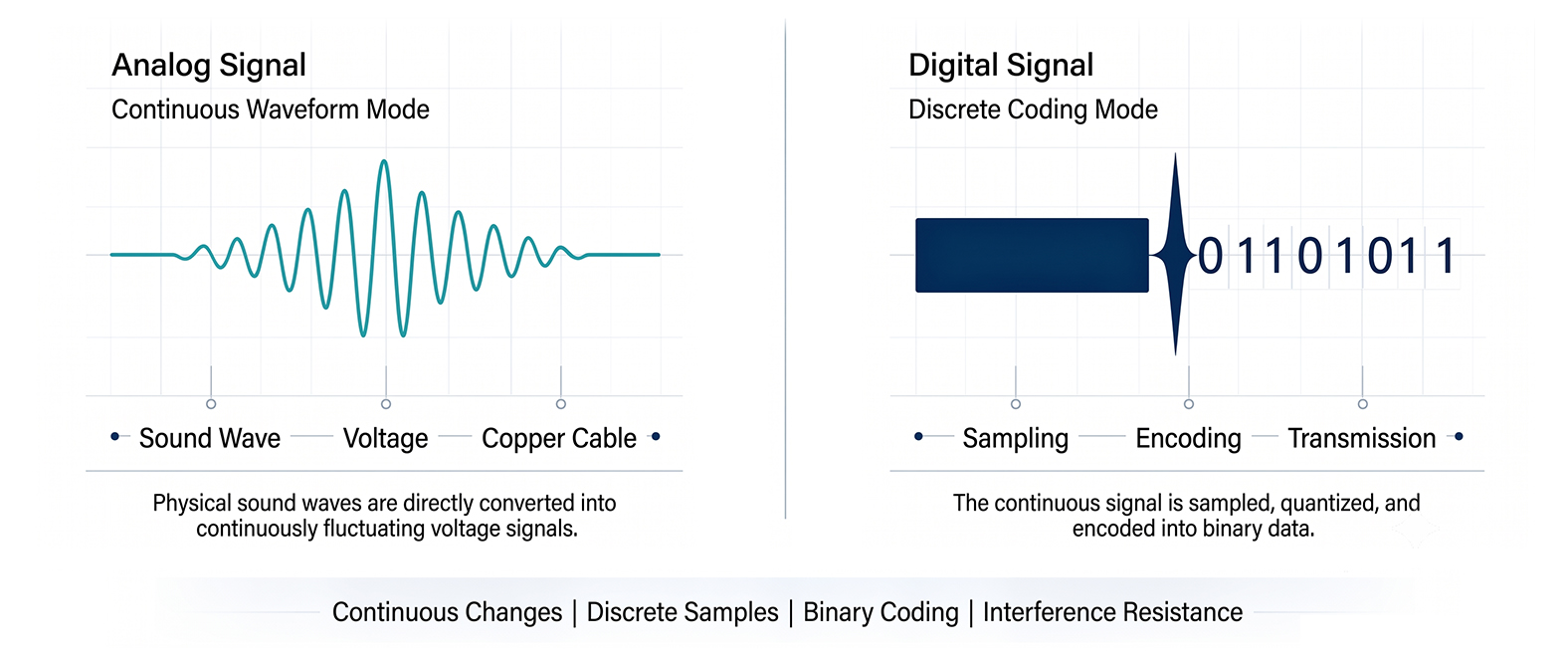
Analog Audio Links:
Sound is represented by continuously varying voltage or current. Common transmission media include
balanced and unbalanced copper cables. Transmission quality is affected by microphones,
preamplifiers, cables, grounding, shielding and electromagnetic environments. When balanced
low-impedance connections, adequate shielding and standardized construction are implemented,
analog links can maintain strong anti-interference performance even over relatively long distances.
Digital Audio Links:
Analog signals are converted into discrete data through sampling and quantization. Standard audio
specifications for conference systems typically include 48 kHz / 24-bit resolution. Digital audio can
be transmitted via AES3, USB, dedicated bus protocols, Ethernet/IP networks (e.g., AES67), fiber
optics or wireless links. As long as the link operates normally without data loss, digital samples
can be reproduced faithfully. However, bit errors, packet loss, clock synchronization issues or
wireless interference may cause audio glitches, stuttering or complete silence.
III. Core Comparison: Analog vs Digital Audio Links
The table below compares typical engineering characteristics of analog and digital audio links. Actual performance varies based on interface standards, product design, construction quality and system configuration; the two formats cannot be simply equated to "wired vs wireless" or "small vs large meeting rooms".
Comparison Dimension | Analog Audio Links | Digital Audio Links | Key Selection Considerations |
Signal Representation & Media | Sound represented via continuous voltage/current; primarily transmitted over balanced/unbalanced copper cables. | Sound represented via sampled, quantized digital data; transmissible via serial interfaces, dedicated buses, Ethernet, fiber optics or wireless channels. | "Analog/Digital" is not equivalent to "Wired/Wireless". Verify actual interfaces and system topology. |
Anti-Interference & Transmission Distance | Balanced low-impedance cables offer decent interference resistance; poor grounding, insufficient shielding or excessively long cables introduce noise. | Data can be stably reproduced within link margin; bit errors, packet loss or wireless interference trigger audio anomalies. | Evaluate cable specifications, network architecture, RF environment, redundancy and construction standards. |
Latency & Signal Processing | Pure analog links have negligible latency with no sampling, algorithmic or buffering delays. Latency only arises if digital DSP units are connected downstream. | End-to-end latency typically ranges from hundreds of microseconds to multiple milliseconds, determined by AD/DA conversion, DSP algorithms, network transmission and buffer settings. | Measure actual end-to-end latency for local sound reinforcement, audio monitoring and AV synchronization scenarios. |
Functionality & Scalability | Straightforward architecture with simple debugging; adding audio channels requires corresponding increases in cables and interfaces. | Supports flexible signal routing, automatic mixing, AEC, noise reduction, audio recording and centralized management; available functions depend on specific hardware models. | Select based on functional requirements, management needs and expansion roadmap, rather than room headcount. |
Cost & Maintenance | Lower upfront costs for fixed small-scale channel deployments; cabling and renovation costs rise sharply as system scale expands. | Higher investment in hardware, network infrastructure, software licensing, battery charging and maintenance; centralized management reduces long-term operational costs for large systems. | Compare total lifecycle costs instead of only unit hardware prices. |
IV. How to Choose a Conference Room Audio System

1.Scenarios Suitable for Analog Links or Simple Hybrid Solutions
Basic functionality with limited audio channels: Systems requiring only a small number of fixed microphones, local sound reinforcement or basic audio recording, with no demand for AEC, automatic mixing or centralized management. Analog links or analog-dominant hybrid architectures deliver simpler operation.
Pre-existing analog infrastructure: Retain legacy cables, mixing consoles and power amplifiers with limited future expansion plans to avoid full system replacement and cut costs. Note that even with analog microphones at the input stage, a digital DSP with AEC functionality is still required for remote video conferencing.

2. Scenarios Suitable for Digital DSP, Networked or Wireless Solutions
Frequently rearranged spaces or restricted cabling: Wireless conference microphones eliminate damage to desktops and interior finishes during wiring renovations. However, full evaluation is required for spectrum planning, signal coverage, battery charging management, encryption capabilities and backup protocols for interference scenarios. Digital wireless systems do not inherently guarantee interference-free operation or robust security; performance is determined by individual product specifications and configuration.
Complex functional demands or centralized management requirements: Digital DSP and networked architectures excel for systems requiring multi-microphone automatic mixing, acoustic echo cancellation (AEC), noise suppression, feedback suppression, recording, speaker management, voting, simultaneous interpretation, remote monitoring or cross-room audio routing. These functions are not universally available on all digital devices and must be verified against product datasheets.
3. Critical Pre-Selection Validation Criteria
Usage Patterns & Microphone Types
Clarify core use cases: Local sound reinforcement only, or remote video conferencing, recording, live streaming and simultaneous interpretation?
Define microphone layout and purpose: Fixed desktop/gooseneck microphones for local sound reinforcement prioritize gain and acoustic feedback suppression; boundary microphones or ceiling microphone arrays for remote pickup focus on full-room speech clarity and noise reduction (local loudspeaker gain should be limited to avoid acoustic feedback).
Signal Latency & Acoustic Environment
Distinguish core technical priorities for local vs remote conferencing: Remote video conferencing centers on eliminating far-end echo via AEC, while local sound reinforcement focuses on suppressing on-site acoustic feedback and howling. Meanwhile, verify that end-to-end latency introduced by AD/DA conversion and DSP processing does not degrade local audio experience.
System Scale & Expandability
Calculate current and future requirements for microphones, audio input/output ports and inter-room system linkage.
Existing Infrastructure
Assess compatibility of legacy cabling, network switches, PoE power supplies, server cabinets and wireless spectrum environments.
Security & Reliability
Confirm requirements for data encryption, user authentication, network isolation, hardware redundancy, fault monitoring and backup contingency plans.
Operation, Maintenance & Total Cost of Ownership
Identify responsible parties for system commissioning and maintenance; calculate long-term expenses including hardware, software licenses, battery replacement, charging equipment and facility renovation.
V. Conclusion
Analog and digital technologies are not mutually exclusive in modern conference room deployments. Hybrid architectures are the mainstream solution: analog microphones capture sound at the input stage, digital DSP units handle signal processing, IP networks transmit audio streams, and analog power amplifiers drive loudspeakers for sound output.
Analog links feature a direct, easy-to-debug structure with no perceptible latency from sampling, algorithmic processing or signal buffering. Digital links enable flexible signal processing, routing, monitoring and system expansion, yet introduce end-to-end latency ranging from hundreds of microseconds to multiple milliseconds, and rely on properly configured networks, wireless hardware and system logic. Reliability for both architectures hinges on qualified hardware and standardized engineering design & construction.
The optimal selection methodology avoids drawing arbitrary capacity thresholds for analog/digital systems. Instead, define performance and functional objectives first, then cross-verify hardware specifications, end-to-end latency, cabling/network infrastructure, security standards, scalability and total lifecycle costs. Prototype testing or on-site acoustic measurements can be conducted for validation if necessary.