

When communicating with global partners, system integrators, and end users, we are often asked the following question:
Should you choose UHF, infrared, 1.9 GHz, or 2.4/5 GHz for your wireless conferencing system?
Looking at frequency bands alone, it's difficult to get a complete answer to this question. A review of the development of global wireless conferencing systems reveals that the evolution of technology has not been a simple upgrade from low to high frequencies, nor has it been a complete replacement of one technology by another.
The real change behind it is the demand for meeting spaces:
From initially getting rid of cables to simultaneously transmitting audio and control data; from completing basic speeches to managing identities, voting, and device status; and then to connecting cameras, sound reinforcement, recording, remote conferencing, and multi-conference room systems.
Following this development logic, we can roughly divide the technological evolution of global wireless conferencing systems into four stages.
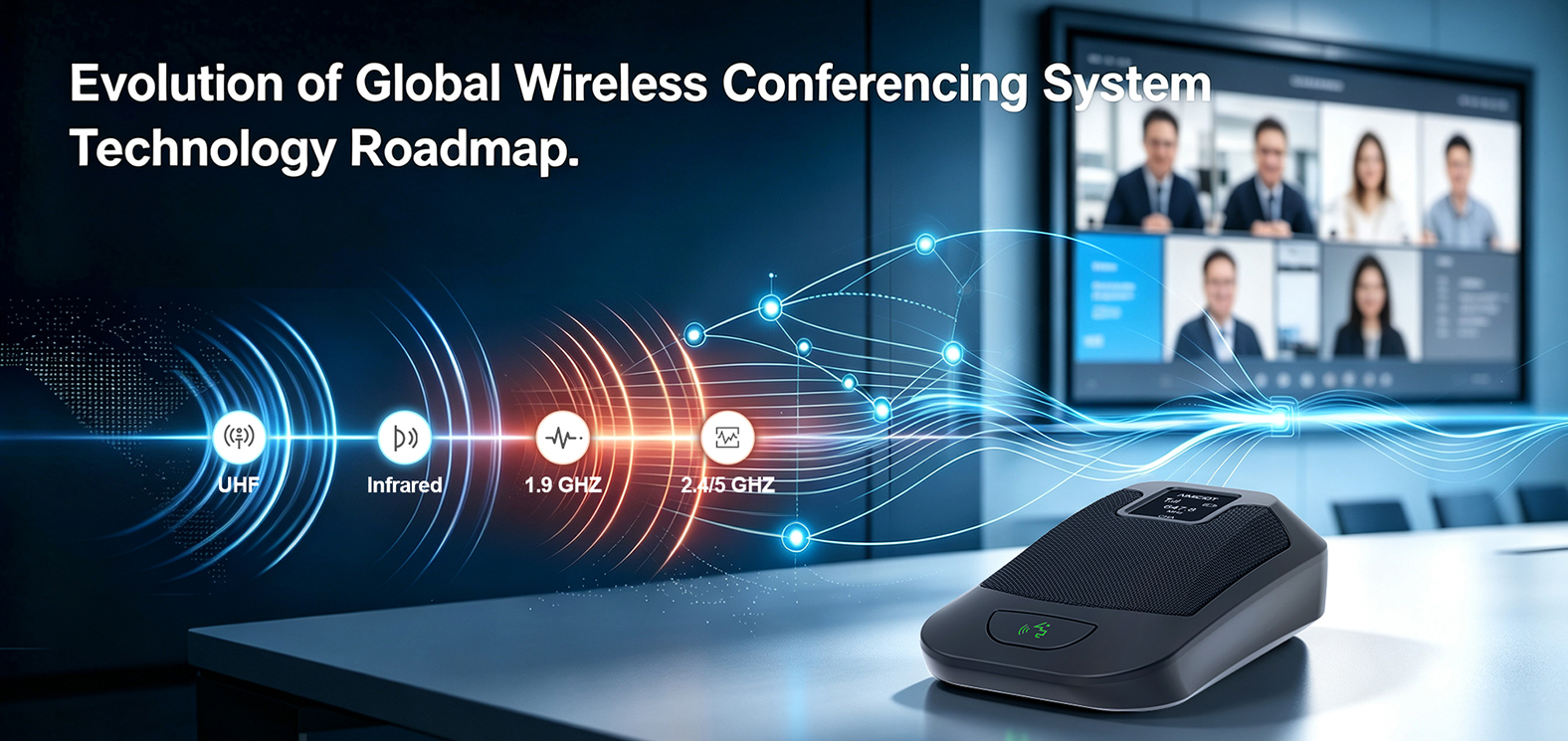
Phase 1: Wireless Transmission – First, get conference microphones free from cables.
Early conferencing systems primarily relied on wired connections. However, with increasing demands from changes in conference room table layouts, ad-hoc meetings, and renovations of historic buildings, reducing cabling limitations became the primary challenge for wireless conferencing systems.
During this stage, UHF and infrared gradually formed two representative technical routes: one using radio transmission and the other using optical signal transmission.
They all address the "wireless" problem, but they employ completely different engineering approaches.
UHF: Emphasis on real-time audio link and spatial adaptability
The UHF approach follows the engineering approach of professional wireless microphones, focusing on establishing a relatively independent, low-latency real-time audio link.
Compared to 2.4/5 GHz routes, the UHF professional wireless audio links commonly used in conference systems typically have better propagation and diffraction conditions, and are more likely to adapt to human body obstruction and complex spaces; compared to infrared, it does not rely on strict optical line of sight, and is easier to maintain coverage in environments where conference tables, people and equipment are constantly moving.
The advantages of digital UHF in terms of audio stability, low latency, and low power consumption have become an important foundation for AIMICIOT to build its own technology roadmap. We will explain this further in the architecture evolution section of this article.
The engineering cost of the UHF route is that it is more dependent on frequency planning. Available frequency bands, transmit power, number of channels, and certification requirements will vary from market to market. When multiple systems are running simultaneously, adjacent channels, intermodulation, antenna locations, and other wireless devices on site also need to be considered.
Therefore, compared to infrared, UHF reduces the reliance on optical line of sight, but increases the requirements for wireless spectrum coordination; compared to 2.4/5 GHz WLAN, it focuses more on professional real-time audio links, but usually requires a separate control architecture for data carrying and network management.
For professional wireless audio equipment in the European market, standards such as ETSI EN 300 422-1 provide corresponding radio technology and testing guidelines.
Infrared: Trading spatial boundaries for stricter coverage conditions
Infrared conferencing systems are not a new technology that has only emerged in recent years.
Audio-Technica's official historical records , its infrared microphone products date back to the 1990s, and its ATCS conference system entered the market around 2000. TAIDEN, on the other hand, launched its HCS-5300 digital infrared conference system in 2008.
The biggest difference between infrared and UHF, 1.9 GHz and 2.4/5 GHz routes is that it transmits signals in space via optical signals rather than radio signals.
Infrared signals are generally easier to confine within a room, have weaker wall penetration, and do not occupy radio spectrum. Therefore, they are suitable for locations with many adjacent meeting rooms, where it is necessary to reduce cross-room wireless interference, or where the radio environment is relatively complex.
Compared to UHF, infrared reduces the pressure of frequency planning; however, it relies more heavily on radiating element layout, receiver field of view, spatial reflection, and blockage control. In meeting rooms with complex shapes, high population density, or strong ambient light, more detailed optical coverage design is typically required.
Infrared room boundaries cannot be directly equated with system security. Authentication, access permissions, encryption mechanisms, and on-site management are still essential.
IEC 61603-7:2003 describes digital multi-channel, multi-carrier infrared audio transmission systems for conferencing and similar applications, and is an important standard for this route.
Representative products include the TAIDEN HCS-5300 and Audio-Technica ATUC-IR. The ATUC-IR can be deployed in conjunction with the ATUC-50 wired system, illustrating that infrared technology later began to evolve from single-wireless transmission to system-wide collaboration.
Phase 2: Digitalization – From Transmitting Voice to Two-Way Management
Wireless technology has solved the limitations of cables, but formal meetings require more than just audio.
With the gradual addition of functions such as speaking requests, chairman control, terminal identification, battery status, and device management, wireless conferencing systems have begun to shift from simple audio transmission to two-way communication of audio and control data.
1.9 GHz DECT is a representative route in this stage of development.
1.9 GHz DECT: Enhanced bidirectional access and terminal management
The DECT route emphasizes controlled access, two-way communication, and terminal management.
Compared to traditional UHF professional wireless audio routes, DECT is better suited to integrating voice, control, and device status into a single wireless system; compared to 2.4/5 GHz WLAN, it typically does not share the same set of working channels directly with common office wireless LANs, thus reducing direct competition between conference audio and everyday data networks.
However, DECT is not a single solution with the exact same configuration used globally. Different markets may require different product versions and certifications, and its concurrent channels, terminal capacity, and coverage also depend on the specific system architecture.
The Yamaha RM-W is one of the representative products in the field of wireless voice pickup in collaborative conference rooms using the 1.9 GHz route.
It is important to note that this type of wireless microphone system is not entirely the same product type as formal conference systems with chairman, delegate, voting, and simultaneous interpretation functions, and cannot be compared horizontally based solely on frequency bands.
Overall, compared to the UHF route, DECT enhances bidirectional access and terminal management; compared to the WLAN route, it reduces the possibility of direct competition with conventional office networks, but conditions such as regional version, concurrent capacity, and system ecosystem need to be considered.
Phase 3: Networking – Wireless conferencing becomes part of the conferencing network
As meeting functions continue to expand, stronger two-way data capabilities are needed for identity authentication, speech queues, voting, language selection, software control, remote operation and maintenance, and device status.
Wireless conferencing systems thus entered the networking stage, with 2.4/5 GHz WLAN gradually becoming an important technology route.
2.4/5 GHz WLAN: Trading data capabilities for higher network planning requirements
Compared to UHF and infrared, 2.4/5 GHz WLAN has a more mature network ecosystem and stronger bidirectional data carrying capacity, making it suitable for integrating conferencing terminals, management software and other audio and video devices into a unified network.
For example, the Shure MXCW uses the 2.4/5 GHz spectrum and provides automatic frequency coordination, channel quality monitoring, and browser-based system management; the Bosch DICENTIS Wireless operates with 2.4/5 GHz wireless and centralized configuration; and the Televic Confidea G4 combines wireless conferencing terminals, identification, voting, and meeting management into a single system.
These products embody the evolution of wireless conferencing systems from "wireless microphones" to "networked conferencing platforms".
Compared to 1.9 GHz DECT, the WLAN route offers greater data capacity and richer network functionality; however, it is also more susceptible to interference from office wireless networks, mobile devices, and other devices sharing the spectrum. Some 5 GHz channels may also involve Dynamic Frequency Selection (DFS) requirements.
Therefore, the capabilities of the 2.4/5 GHz route come not only from the frequency band itself, but also from channel monitoring, automatic coordination, network isolation, quality of service settings, and system management.
If UHF focuses more on real-time professional audio, infrared focuses more on spatial boundaries, and 1.9 GHz DECT focuses more on controlled wireless access, then the more prominent value of 2.4/5 GHz WLAN is data carrying and networking.
Correspondingly, it also relies more heavily on IT networks and wireless environment planning.
Phase 4: Architecture Evolution – From Selecting Frequency Bands to Reorganizing Transmission Links
As wireless conferencing systems entered the networking phase, the industry's focus shifted once again.
In the past, projects primarily considered "which frequency band should be used"; now, system design also needs to consider: must audio and control data be transmitted through the same link? Must wireless receiving equipment be centrally installed in a server room far away from the meeting venue?
This has driven wireless conferencing technology to gradually shift from performance competition in a single frequency band to a holistic architecture design encompassing transmission links, receiving devices, and back-end management.
Architectural innovation does not necessarily mean adding more wireless links; it can also mean redefining the deployment of audio, data control, and receiving devices while retaining the advantages of professional audio transmission.
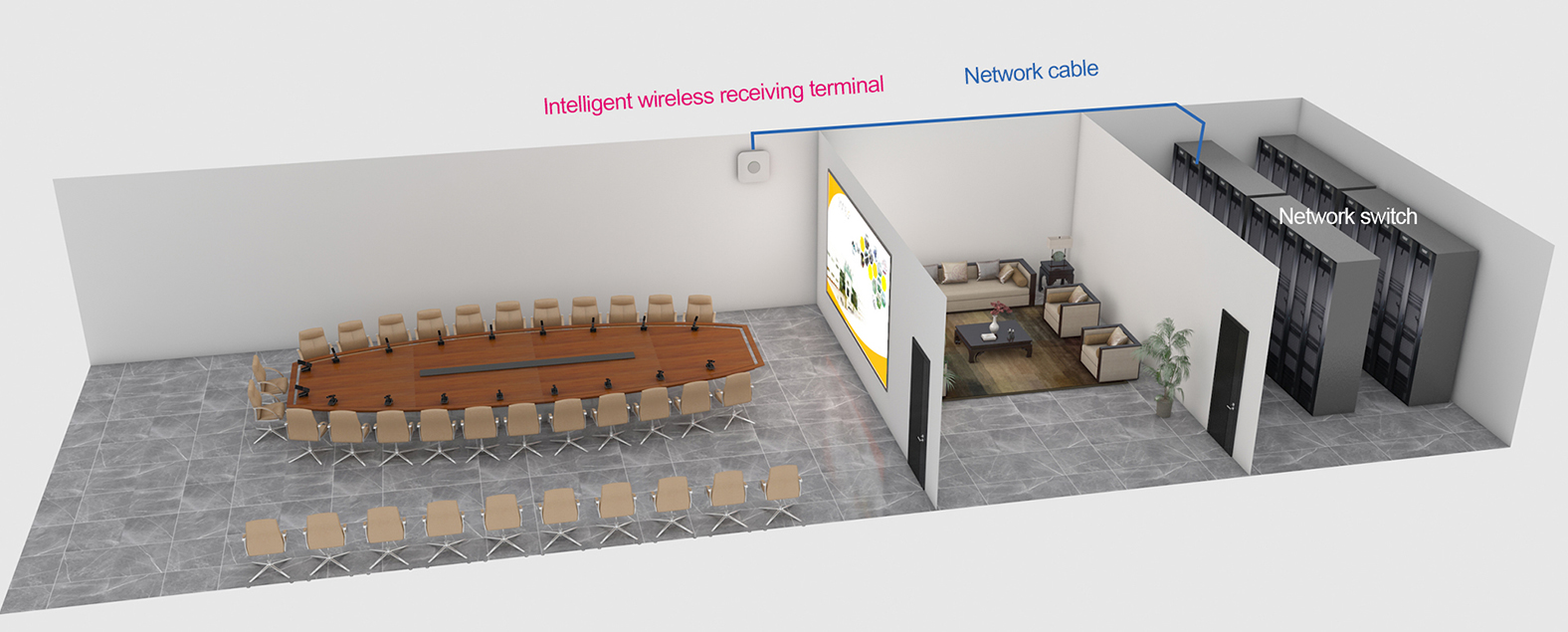
AIMICIOT's technical path: combining the advantages of digital UHF with 5G architecture.
AIMICIOT combines the transmission advantages of digital UHF with the efficient wireless transceiver approach of 5G architecture to propose a unique wireless conferencing technology path. The system adopts an architecture that separates data control from audio transmission, and borrows the deployment method of 5G access devices close to the usage site, installing the wireless receiver directly at the meeting site, and then connecting to the meeting host and back-end system via the network.
This can shorten the reception distance of UHF signals and reduce the loss caused by long-distance antenna feeders; in projects that meet the coverage and installation requirements, it can eliminate the need to add antenna amplifiers when deploying UHF signals over long distances in the traditional way.
Using digital UHF to transmit real-time audio has three main advantages:
Improve audio stability. Separating audio from data control reduces the impact of control and management operations on the audio link, focusing on resolving the stability issues of real-time audio.
Reduce audio latency. Under AIMICIOT's current product architecture and testing conditions, the audio transmission latency of digital UHF is significantly lower than that of transmitting audio directly using a 5G wireless link. This helps reduce the lag in live sound reinforcement and enhances the naturalness and presence of the sound.
Reduced terminal power consumption. Digital UHF audio transmission requires less terminal power, which helps extend the battery life of wireless conferencing units.
Different technical approaches still have their own applicable boundaries.
From the perspective of the development of global wireless conferencing technology, the relative characteristics of each approach can be summarized as follows:
The advantages of UHF are professional real-time audio links, propagation capabilities, low latency, and low terminal power consumption. The main engineering requirements are spectrum planning, antenna design, and regional compliance.
The advantages of infrared are clearer room boundaries and no occupation of the radio spectrum. The main engineering requirements are optical line of sight, shielding and coverage design.
The advantages of 1.9 GHz DECT are controlled bidirectional access and terminal management. The main engineering conditions are regional version, system capacity and product ecosystem.
The advantages of 2.4/5 GHz WLAN are data capabilities, software management, and network expansion. The main engineering requirements are shared spectrum, DFS requirements, and IT network planning.
An architecture that separates audio and data control and places the receiving equipment close to the field can leverage the real-time audio advantages of digital UHF and reduce losses caused by long-distance antenna feeders, but it also places higher demands on system connectivity, field deployment, and unified management.
There is no single ranking of these routes that applies to all projects. Venue layout, seating arrangements, concurrency levels, meeting capabilities, on-site spectrum, and target market compliance requirements all influence the final selection.
Global Application: Standards provide the basis, but market access still requires item-by-item confirmation.
Global Wireless Conference Systems need to meet system standards, radio standards, and local market access requirements simultaneously.
At the system level, ISO 22259:2019 sets requirements for typical conference systems and their constituent equipment, and applies to both wired and wireless systems.
Regarding specific transmission routes, infrared systems can refer to IEC 61603-7, while professional wireless audio and 2.4/5 GHz equipment need to be designed and tested in accordance with the corresponding regional radio standards.
However, compliance with a particular international or regional technical standard does not automatically grant a product access to the global market. Different markets may have differences in available frequency bands, power limits, channel conditions, indoor usage rules, and product certifications.
Therefore, the focus of global projects is not simply replicating the same wireless configuration, but rather confirming whether the product version, certification documents, field spectrum, and actual system configuration correspond to the target market. Before formal delivery, a review is still required in accordance with the current requirements of the local regulatory authorities.
Conclusion
Looking back at the evolution of global wireless conferencing system technology, what we see is not one frequency band replacing another, but rather the continuous expansion of the capabilities of conferencing systems:
From solving wireless issues with UHF and infrared, to enhancing bidirectional access with 1.9 GHz DECT, and then to driving networking with 2.4/5 GHz WLAN, the ultimate goal is to innovate the architecture of audio transmission, data control, and field access methods.
The choice of technology has therefore gradually shifted from "which frequency band is better" to "how to better coordinate transmission methods, equipment deployment, and system management".
Frequency bands determine basic propagation conditions, architecture determines how different technologies are organized, and compliance, design, and operation and maintenance ultimately determine whether a wireless conferencing system can serve real meetings in the long term.