

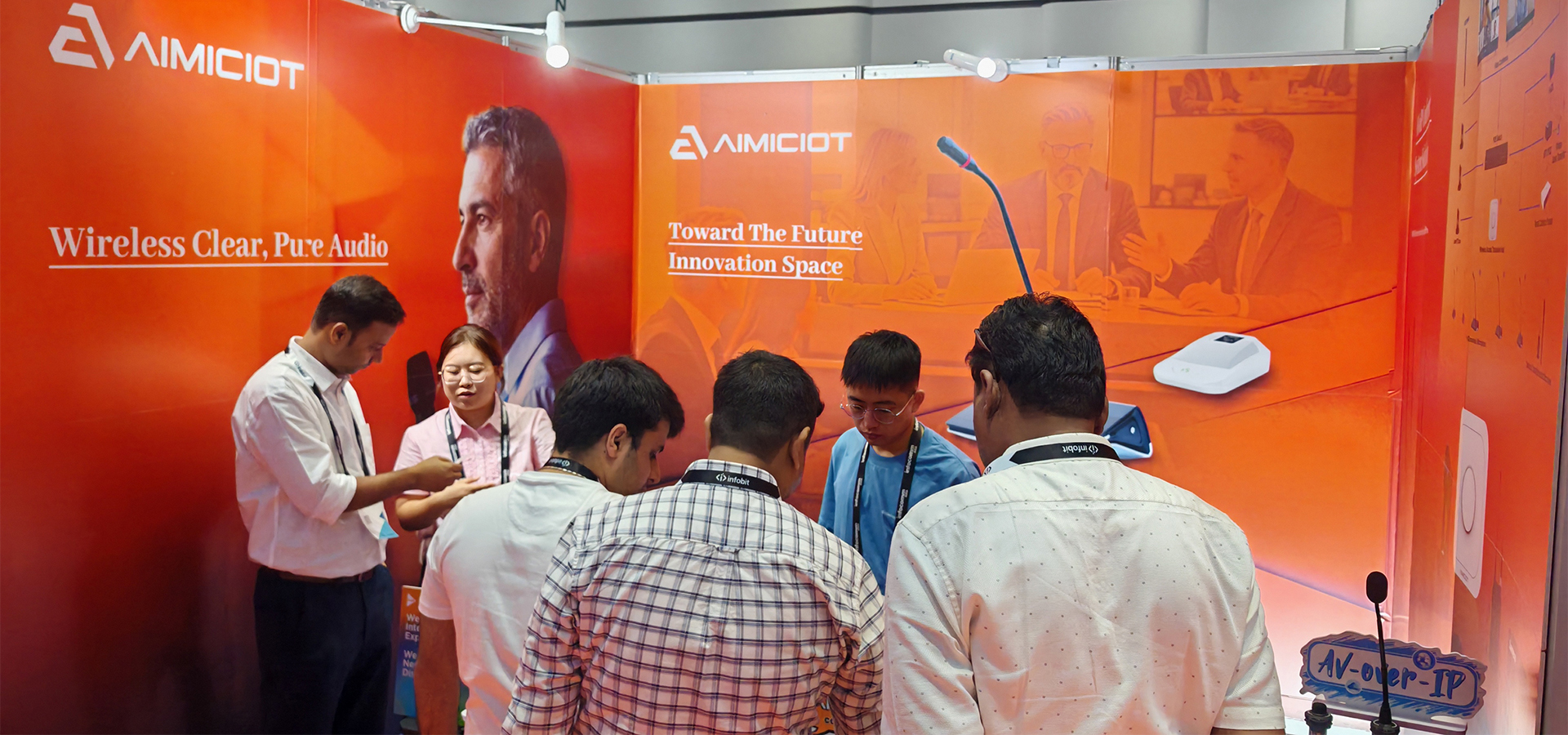
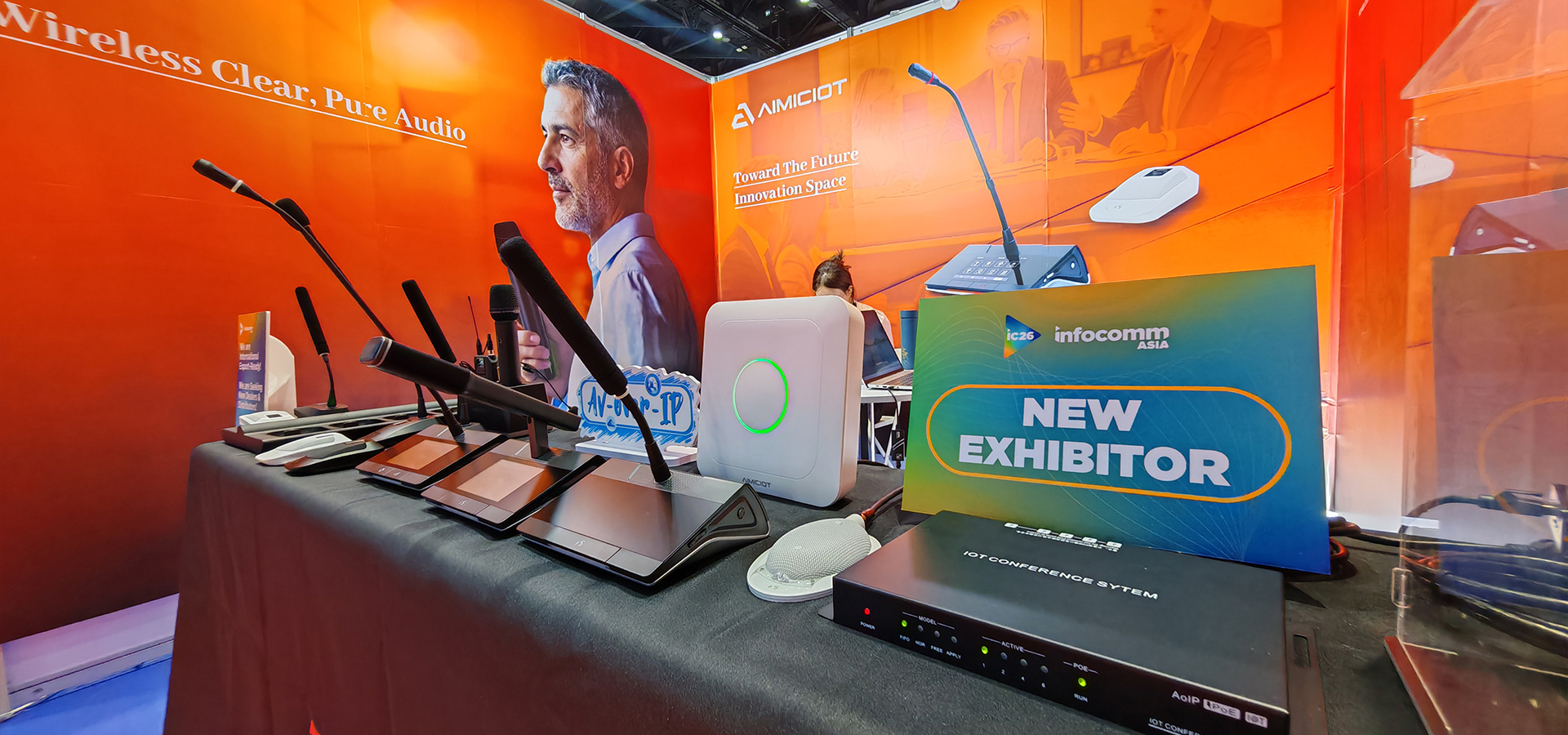
At the recently concluded exhibition, we received many system integrators, engineers, and overseas buyers who came to experience and discuss our products. During our discussions, we discovered a very interesting phenomenon: " Many customers assumed that our wireless microphones and conferencing systems used 2.4G or 5G wireless technology." However, our professional wireless products do not use 2.4G or 5G, but rather UHF (ultra-high frequency) digital true diversity transmission technology.
Why do we insist on UHF?
1.Propagation Characteristics and Coverage Capability
2.4GHz and 5GHz belong to the ISM (Industrial, Scientific, and Medical) open frequency bands, which can be used by any device without a license. This brings widespread adoption, but also a fatal problem—frequency band congestion.
In crowded environments such as exhibitions, hotels, and office buildings, a large number of mobile phones, laptops, routers, and Bluetooth devices work simultaneously, severely congesting channel resources. Wi-Fi uses the CSMA/CA mechanism, which requires devices to "listen before transmitting." When interference is severe, a large number of packets are lost and retransmitted, which manifests in audio as audio dropouts, stuttering, and latency fluctuations.
UHF professional wireless microphones operate in broadcast-dedicated frequency bands (typically in the 470–698 MHz range), physically isolated from civilian communication frequency bands, eliminating the "network snatching" problem. Each frequency transmits independently, unaffected by on-site Wi-Fi or Bluetooth devices.
For professional conferences and performances that cannot be interrupted, this level of certainty in the face of disruption is a minimum requirement.
2.Propagation Characteristics and Coverage Capability
From the physical laws of electromagnetic wave propagation, the higher the frequency, th
e shorter the wavelength, the weaker the diffraction and penetration ability, and the faster the attenuation.
technology | Frequency band range | wavelength | Diffraction/penetration capability | Typical environmental coverage distance |
5G Wi-Fi | 5.150 – 5.875 GHz | Approximately 5 cm | Weak, severe attenuation due to partition walls | 10 – 20 m (sight distance) |
2.4G Wi-Fi | 2.4 – 2.483 GHz | Approximately 12 cm | Moderate, with significant attenuation due to human occlusion. | 20 – 30 m (line of sight) |
UHF band | 470 – 69 4 MHz | Approximately 43 – 64 cm | Strong, capable of diffusing through walls, and easily bypasses crowds. | 50 – 100 m+ (complex environment) |
In complex environments such as large exhibition halls and multi-partitioned conference rooms, the effective coverage distance of UHF is usually 3–5 times that of 2.4G solutions, and the signal stability is much less affected by people moving around or furniture placement.
3.Sound Delay: One is inconsistently fast and slow, the other is consistently very low.
2.4G/5G: High latency and unstable
2.4G/5G devices based on standard Wi-Fi protocols suffer from high latency and are prone to fluctuations due to the CSMA/CA handshake mechanism and retransmission strategy.
What problems arise from high latency? When speaking with speakers on, if the sound from the microphone is half a beat slower than expected, it will cause feedback, which is a major taboo in professional audio.
UHF: Extremely low and constant latency
Professional audio equipment in the UHF band uses a narrowband transmission method specifically designed for sound transmission. It doesn't involve many complicated steps, essentially acting as a "fast track." The delay from the transmitter to the receiver can be controlled within 3 milliseconds, and this speed is always maintained without any fluctuations.
4.Using multiple microphones simultaneously: one microphone consumes bandwidth, while others operate independently.
If a meeting room only has one or two microphones, the difference isn't significant. However, in large roundtable conferences or discussions with dozens of people, where many microphones are used simultaneously, the difference becomes apparent.
2.4G/5G: All devices share the same bandwidth. The more microphones connected, the less resources each microphone receives, resulting in higher latency and a greater likelihood of lag. Generally, connecting 4-8 high-quality microphones simultaneously is close to the limit.
UHF: Each microphone operates on its own independent frequency, without interfering with each other. As long as the frequency planning is reasonable, it is possible to use twenty, thirty, or even fifty microphones simultaneously without any problems.
5.Key to UHF Selection: Global Frequency Band Compliance
UHF has clear technological advantages, but there is a real problem that must be addressed: different countries have different radio management policies, and the legally used frequency bands vary greatly.
In recent years, spectrum refarming has been ongoing globally, with large amounts of 600MHz and 700MHz bands being auctioned off to mobile communication operators. The same frequency band may be legal in country A but banned in country B.
The following is a summary of legal frequency bands for wireless microphones in major global markets:
Country/Region | Main legal frequency bands | Maximum transmit power | Things to pay attention to |
USA | 470–608 MHz (Specific low-power applications are permitted in 614–616 MHz and 657–663 MHz) | 50 mW EIRP | The 608–614 MHz band (Channel 37) is a dedicated frequency band for radio astronomy and medical use; its use is strictly prohibited. |
Canada | 470–608 MHz (614–616 MHz and 657–663 MHz allow for specific low-power use) | 50 mW EIRP | The 608–614 MHz band (Channel 37) is a dedicated frequency band for radio astronomy and medical use; its use is strictly prohibited. |
EU | 470 – 694 MHz 823–832 MHz 863 – 865 MHz (No license required) | 50 mW ERP | ⚠️ 694–790 MHz has been allocated to 4G/5G and is unusable. |
U.K. | 470 – 694 MHz 173.8–175 MHz (no license required) | 50 mW ERP | This is the VHF unlicensed low-power band, applicable only to certain low-power micro-devices. |
Australia | 520 – 694 MHz 174 – 230 MHz | 100 mW EIRP | The regulations are relatively lax in the Asia-Pacific region. |
Japan | 806 – 810 MHz (General Type B) 470 – 710 MHz (Professional Type A) | 10 mW (Type B) 50 mW (Type A) | The frequency band is different from those in Europe and America. For general projects, please look for the 800MHz Type B. |
New Zealand | 520 – 576 MHz 630 – 693.8 MHz | 50 mW EIRP | The frequency band is divided into several segments, so you need to pay attention when selecting a model. |
Singapore | 470 – 694 MHz designated channel | 50 mW EIRP | There's a lot of interference in the city, so it's best to scan the frequencies before starting a project. |
Thailand | 694 – 703 MHz 748 – 758 MHz | 50 mW EIRP | For the Southeast Asian market, compliance with the latest NBTC TS 1006 standard and application for type approval are required. |
Brazil (South America representative) | 470.2–550 MHz 520–607.8 MHz 614.2–693.8 MHz 902–907 MHz 915–927.75 MHz | 50–100 mW | Requires dual certification from Anatel and Inmel; licenses are required for some frequency bands. |
Argentina, Colombia, Peru, Paraguay (applicable to all South American countries) | 470–608 MHz 902–928 MHz | 50 mW | The 900MHz sub-band is mostly low-power and license-free, while the 600MHz band is restricted in some areas. |
South Africa (Africa Representative) | 470–694 MHz | 50 mW ERP | Following the African Unified Spectrum Planning (AfriSAP), priority is given to the 470-694MHz range. |
Most African countries (Nigeria, Uganda, Tanzania, etc.) | 470–694 MHz | 50 mW | Following the ITU Zone 1 standard, there are no separate frequency bands; frequency applications must be submitted to the local telecommunications bureau before deployment. |
Friendly reminder: Using wireless devices on illegal frequency bands will result in fines and equipment confiscation in most countries. For multinational projects, it is crucial to confirm frequency band compliance in the target market during the selection phase and prioritize professional equipment that supports frequency band customization.
Detailed Explanation of Frequency Bands in Thailand (Latest 2026)
Technology type | Thailand's legal frequency bands | Authorization status | Typical applications | Key Explanation |
UHF wireless microphone (analog/digital) | 694 – 703 MHz, 748 – 758 MHz, and other NBTC-allocated sub-bands. | ✅ Authorized Use ⚠️ Conditional Authorization | Live sound reinforcement, event performances, broadcasting | • Frequency can only be used after NBTC has allocated the frequency. • Equipment from other countries (such as the EU) must have its frequency range verified for compliance before import. • Professional audio outside the UHF band is not permitted. |
DECT Digital Enhanced Cordless Communication | 1880 – 1900 MHz | ✅ No license required (no application needed) | Meeting system, discussion system, chairperson microphone, delegate microphone | • Unlicensed frequency bands specifically designed for DECT equipment • Stable, low interference, and excellent multi-channel performance • Highly recommended for government projects and enterprise installations |
2.4 GHz digital wireless | 2400 – 2483.5 MHz | ✅ License-free (general unlicensed frequency bands) | Live streaming, content creation, mobile applications | • Shares frequency band with Wi-Fi, Bluetooth, and IoT devices. • Susceptible to interference, signal loss may occur. • Not suitable for large events and professional productions; only suitable for small, lightweight applications. |
5 GHz wireless audio/video | 5150–5250 MHz 5250–5350 MHz 5470–5725 MHz 5725–5850 MHz (depending on device type) | ⚠️ Conditional authorization available | Wireless video, presentation system, wireless presentation | • The device must comply with NBTC technical standards (such as DFS dynamic frequency selection). • High bandwidth, low latency, and good sound quality. • Different sub-bands have different power limits. |
VHF ( Very High Frequency) | Multiple frequency bands (most of which are no longer applicable) | ❌ Not recommended/Non-compliant | — | • High risk of interference and potential for illegal operation. • Low spectrum efficiency. • Most VHF bands have been allocated to other services and are unsuitable for modern equipment. |
Summarize
While 2.4G and 5G Wi-Fi technologies are widely used and inexpensive in the consumer electronics field, they cannot meet the requirements of professional audio scenarios in four core dimensions: anti-interference capability, coverage distance, transmission latency, and multi-channel capacity.
With its dedicated spectrum resources, excellent propagation characteristics, extremely low transmission latency, and flexible multi-channel networking capabilities, the UHF band has become the industry standard technical solution for professional wireless conference microphone systems and performance microphones.