

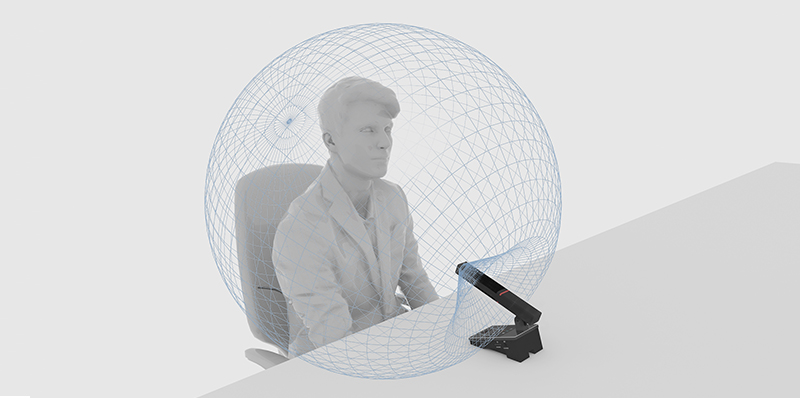
Caption: The directionality of a microphone exists in three-dimensional space. The figure is a conceptual illustration of the pickup range and is not a laboratory measurement result.
Directivity refers to the spatial hearing of a microphone.
In noisy environments, people instinctively turn their attention to the person speaking. Microphones don't have a human hearing system, but through their diaphragm structure, acoustic channels, and signal processing, they can produce different responses to sounds from different directions.
This is microphone directivity: the difference in sensitivity of a microphone to sound incident from different directions.
Directivity is not the same as pickup distance, nor is it a clear boundary: all sound is received within the range, and there is no sound outside the range.
The reality is more like a gradual change. As the sound gradually deviates from the microphone's axis, the response changes accordingly, and the degree of change in low, mid, and high frequencies may not be the same.
Therefore, a professional directional diagram does not express "whether or not it can be heard", but rather "how much sound from different directions will be received".
IEC 60268-4 also lists the directional response diagram as an important characteristic of microphones that needs to be measured and described ( IEC 60268-4:2018 ).
Where does directionality come from?
Directionality is primarily a wave physics phenomenon.
When sound reaches a microphone from different directions, the propagation paths are not exactly the same. Engineers use the time difference, phase difference, and sound pressure difference between the front and back sides of the diaphragm to enhance the response in some directions and reduce the response in others.
The relevant theories can be traced back to wave acoustics, which was gradually established between the 17th and 19th centuries. In 1877-1878, Rayleigh systematically studied vibration, interference, diffraction, and sound propagation in his "Theory of Sound".
With the advent of telephones, radio, and recording, engineers began to apply these theories to solve a very practical problem: how to capture more spoken sounds and less other sounds?
In 1932, Harry F. Olson and Julius Weinberger disclosed a patent for unidirectional sound pickup, which combined sound pressure level response and pressure gradient response to achieve unidirectional characteristics. In 1939, Shure introduced the Unidyne microphone, which was recognized by the IEEE as the first microphone to achieve directional sound using a single dynamic transducer .
Subsequently, microphone directionality evolved from a fixed mode to multi-mode switching and digital variable directionality.
How to interpret a directional chart
Radiation patterns are typically plotted with 0° directly in front of the microphone, 90° to the side, and 180° behind. The farther the curve is from the center, the higher the relative response in that direction; the closer it is to the center, the lower the response.
It's important to note that these radiation patterns are typically normalized. They can help us determine the shape of the spatial response, but they cannot individually indicate the microphone's absolute sensitivity, self-noise, or maximum sound pressure level.
The radiation pattern of the same microphone can change at different frequencies. Therefore, looking at only one curve at 1 kHz is not enough to represent the performance of the entire audio band.
A radiation pattern is typically just a two-dimensional slice of a microphone's three-dimensional response on a measurement plane. In actual use, the microphone's orientation, mounting method, desktop reflections, and distance from the sound source can all affect the final sound pickup performance. When comparing products, in addition to looking at the curves for different frequencies, attention should also be paid to the measurement plane and the test distance.
Omnidirectional capability allows people nearby to converse naturally.
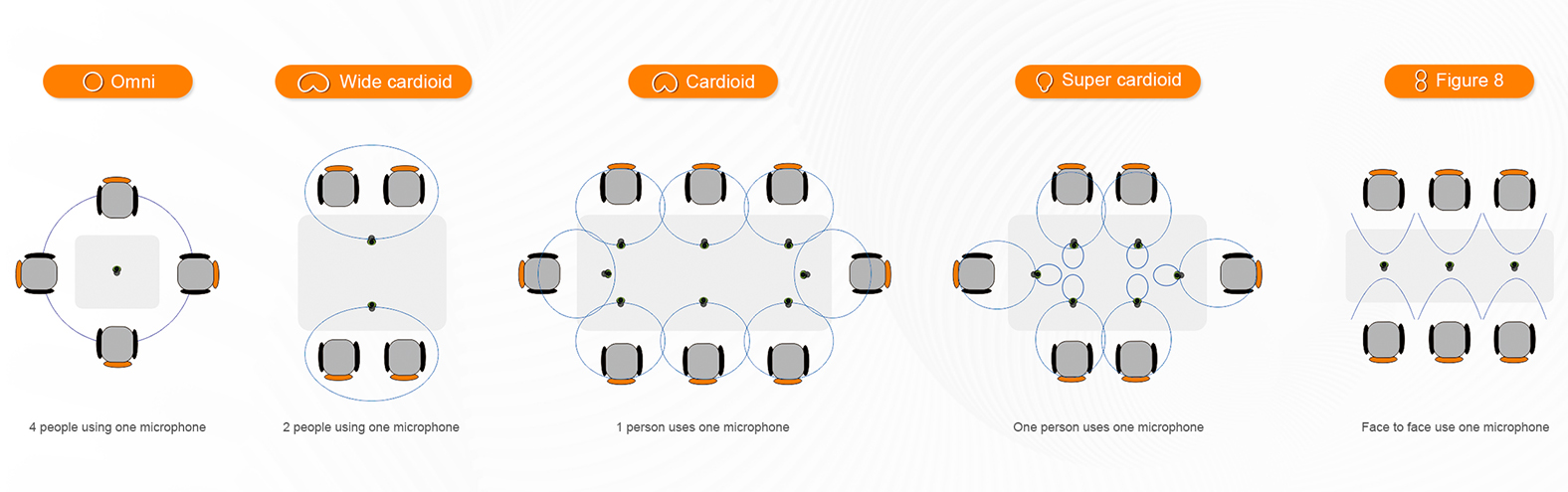
Omnidirectional microphones can pick up sound from all directions, offering relatively fewer restrictions on the direction of speech. They are suitable for small roundtable discussions, situations where the speaking direction is not fixed, or scenarios where a single microphone is needed to serve multiple participants. The sound level typically doesn't drop abruptly when the speaker slightly turns their head. However, this freedom comes at a cost.
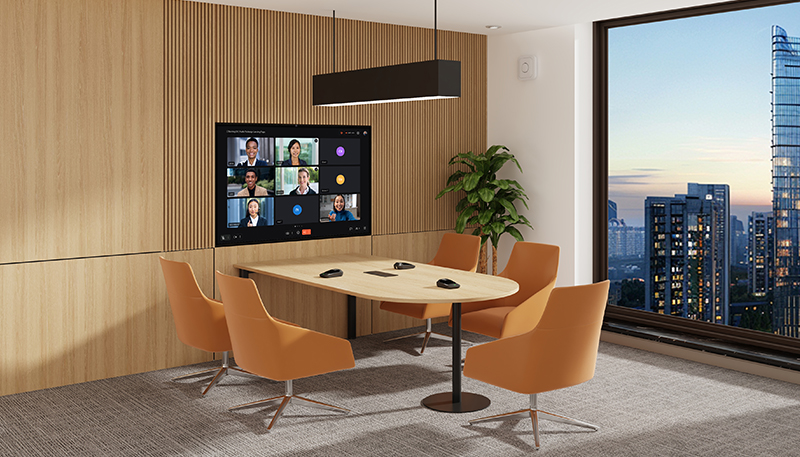
Omnidirectional microphones pick up more air conditioning noise, keyboard clicks, document flipping sounds, and room reverberation. In meeting rooms with high background
noise or strong spatial reflections, special attention needs to be paid to the distance between the microphone and the speaker.
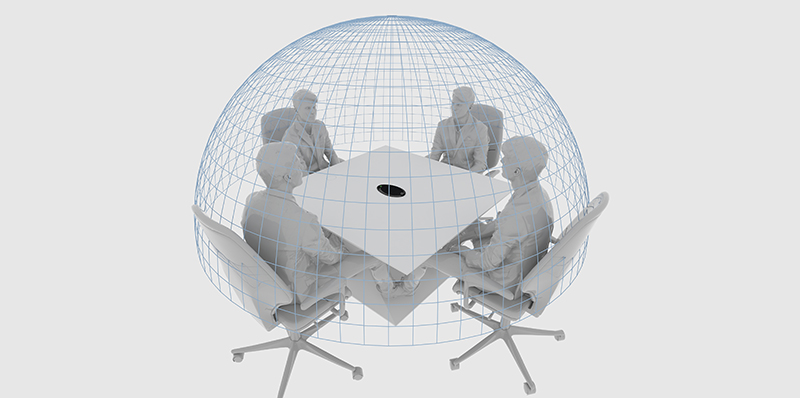
Caption: Omnidirectional mode can cover speakers around the table, while also capturing more ambient sound and room reverberation. The image illustrates the application.
A wide cardioid pattern strikes a balance between coverage and directional choice.
If a microphone needs to serve two adjacent participants, a standard cardioid microphone might be too restrictive, while an omnidirectional microphone might pick up too much ambient noise. A wide cardioid microphone falls somewhere in between. It retains some directional selectivity while providing the speaker with a greater range of lateral movement, making it suitable for two adjacent participants sharing a microphone, or for meeting scenarios where the speaker will turn their head slightly.
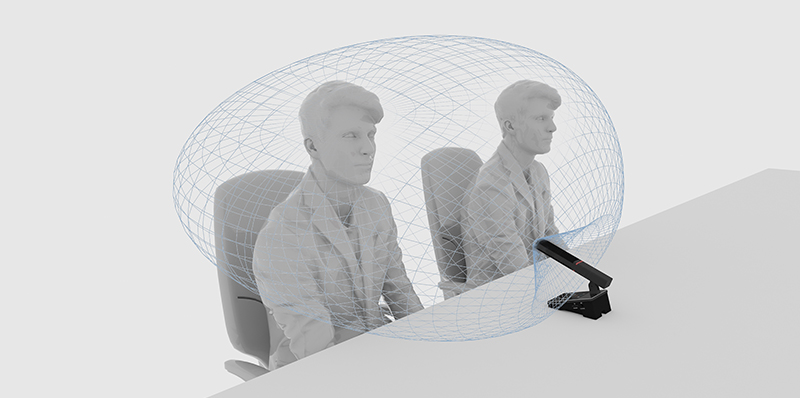
Caption: A wide cardioid pickup pattern provides a wider frontal pickup area that can cover adjacent speakers; however, the actual effect still depends on the speaking distance and room conditions. The image illustrates an application.
Common choices in cardioid fixed seating
Cardioid microphones are typically most sensitive to sound directly in front of them and have a lower response to sound from behind. In conferences with chairpersons, podiums, and fixed seating arrangements, the logic is clear: position the speaker directly in front of the microphone and place the main sources of interference in areas with lower response.
Cardioid patterns can help highlight target speech, but they are not equivalent to automatic noise reduction, nor can they guarantee that the system will never experience acoustic feedback. Speaking distance, microphone angle, number of open microphones, system gain, and room reflections all affect the final result.
"Hyper-cardioid" or "super-cardioid" shapes are more focused and offer greater selectivity in terms of layout.
Compared to standard cardioid cameras, supercardioid and strong cardioid cameras have a more concentrated frontal pickup area and a stronger ability to select for lateral sounds. They are suitable for scenarios where the speaker's location is clearly defined, there is a lot of ambient noise, or where it is necessary to improve the spatial separation between different seats. However, the narrower the direction, the less room for movement is left for the speaker.
When the speaker deviates significantly from the main axis, the sound may decrease rapidly, and high frequencies may also decrease, resulting in a darker timbre. Additionally, such radiation patterns often have a back lobe, and the direction of lowest sensitivity is not necessarily directly behind the speaker.
Therefore, microphone angle and on-site adjustments are especially important when using a narrower directional mode.
The figure-8 pickup pattern is more sensitive to sounds from the front and rear.
A microphone's "figure-8" polar pattern means it is more sensitive to sound coming from the front and rear, while being less sensitive to sound from the left and right sides.
It is suitable for face-to-face conversations, interviews, or scenarios where it is necessary to use a lateral low-sensitivity area to avoid interference.
The bidirectional polarity is not simply "the sum of two hearts". The microphone's front and back output polarities are opposite, and it picks up sound from behind, making it more sensitive to changes in speaking distance.
When placing a microphone, you shouldn't only consider who it's facing directly, but also who its lowest sensitivity direction is facing. The lowest response of a cardioid microphone is usually located directly behind it; supercardioid and strong cardioid microphones have a back lobe, so their lowest response direction is biased towards the rear; the low sensitivity area of a figure-eight microphone is located on the left and right sides. Placing stable sources of interference in these directions is often more effective than simply choosing a narrower directional pattern. The specific angle should be based on the measured directional pattern of the specific model.
What problem does directionality actually solve?
In a meeting system, the value of directionality is mainly reflected in three aspects.
First, highlight the target speaker.
It cannot make noise disappear out of thin air, but it can appropriately reduce some ambient noise and reflected sound from non-target directions, and increase the proportion of target speech in the overall signal.
Second, improve the spatial separation between different speakers.
When each microphone is primarily pointed towards its own speaking area, the sound from other agents entering that channel is typically reduced, providing better input for automatic mixing and subsequent voice processing.
Third, improve the feedback gain of the sound reinforcement system under reasonable placement conditions.
However, acoustic feedback is the result of the combined effects of the microphone, the sound reinforcement equipment, the number of open channels, spatial reflections, and system gain. No microphone can guarantee "no feedback" based on a single radiation pattern.
Why do modern conference rooms need variable orientation?
Traditional conference microphones typically use a fixed pickup pattern, suitable for meeting rooms with clearly defined seating and stable usage patterns. However, modern meeting spaces often serve multiple purposes: a solo presentation in the morning, a two-person negotiation in the afternoon, and a group discussion the next day. As the meeting format changes, the required pickup direction may also change accordingly.
This has driven the development of variable pointing technology.
For example, AIMICIOT's flagship UN series offers a variety of conference unit configurations. Taking the variable-point models such as UN20C-F/UN20D-F and UN520C-S/UN520D-S as examples, users can choose between omnidirectional, wide cardioid, cardioid, supercardioid, and bidirectional modes according to the environment, seating orientation, and conference format.
When speaking alone, a cardioid or supercardioid pattern can be used to make the pickup area more concentrated; when two people are sharing the same space, a wide cardioid pattern can be considered; for small round table discussions, an omnidirectional pattern can be evaluated based on the room noise and reverberation.
Different modes are not simply a matter of magnifying or reducing the same pickup range, but rather different trade-offs in frontal coverage, lateral suppression, and rear response.
For meeting rooms where fixed installation and a tidy desktop are required, the IT80-220 embedded microphone offers an alternative solution. This model supports omnidirectional, widecardioid, cardioid, supercardioid, and bidirectional modes, allowing selection based on the number of speakers, seating arrangements, and ambient acoustics.
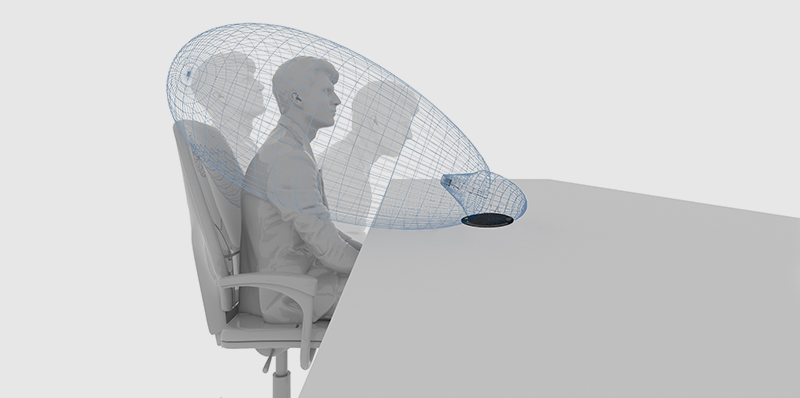
Caption: Fixed interfaces or embedded microphones can select the appropriate directional mode based on the main speaking area. The image illustrates an application.
Whether using UN series conference units or embedded microphones, the value of variable polar pattern lies not in the number of modes themselves, but in making the pickup range more suitable for actual use scenarios.
Is stronger directionality always better?
Too wide a directional field may capture more ambient sound and reverberation; too narrow a directional field may cause speakers who are turning their heads or moving to leave the main pickup area.
A microphone that produces a beautiful cardioid pattern at 1 kHz doesn't mean it will maintain the exact same shape across the entire speech spectrum. Off-axis sound can also produce more than just a drop in volume; it can also result in a noticeable change in timbre. Therefore, when choosing a microphone, the real question shouldn't be: which one is the most directional?
Many directional microphones that use the pressure gradient principle exhibit low-frequency enhancement when the speaker is close to the sound source; this phenomenon is called the proximity effect. It's not necessarily a drawback, but if participants frequently lean forward or backward, the thickness of the sound may change with distance. Therefore, after determining the directional pattern, it's also necessary to check whether the timbre and volume are consistent within the commonly used speaking distance.
Instead:
• What is the noise and reverberation level in the room?
• Is the speaker's position fixed?
• Do you frequently turn your head while speaking?
How many people does one microphone need to serve?
• Is it necessary to switch between multiple meeting formats?
• Can the microphone be placed close to the speaker?
Only when these conditions are put together can the directional chart cease to be just a curve on product data and become a truly valuable engineering tool.
The essence of microphone directionality is not to make the device "hear only one point," but to enable it to better understand where to listen in complex spaces.