
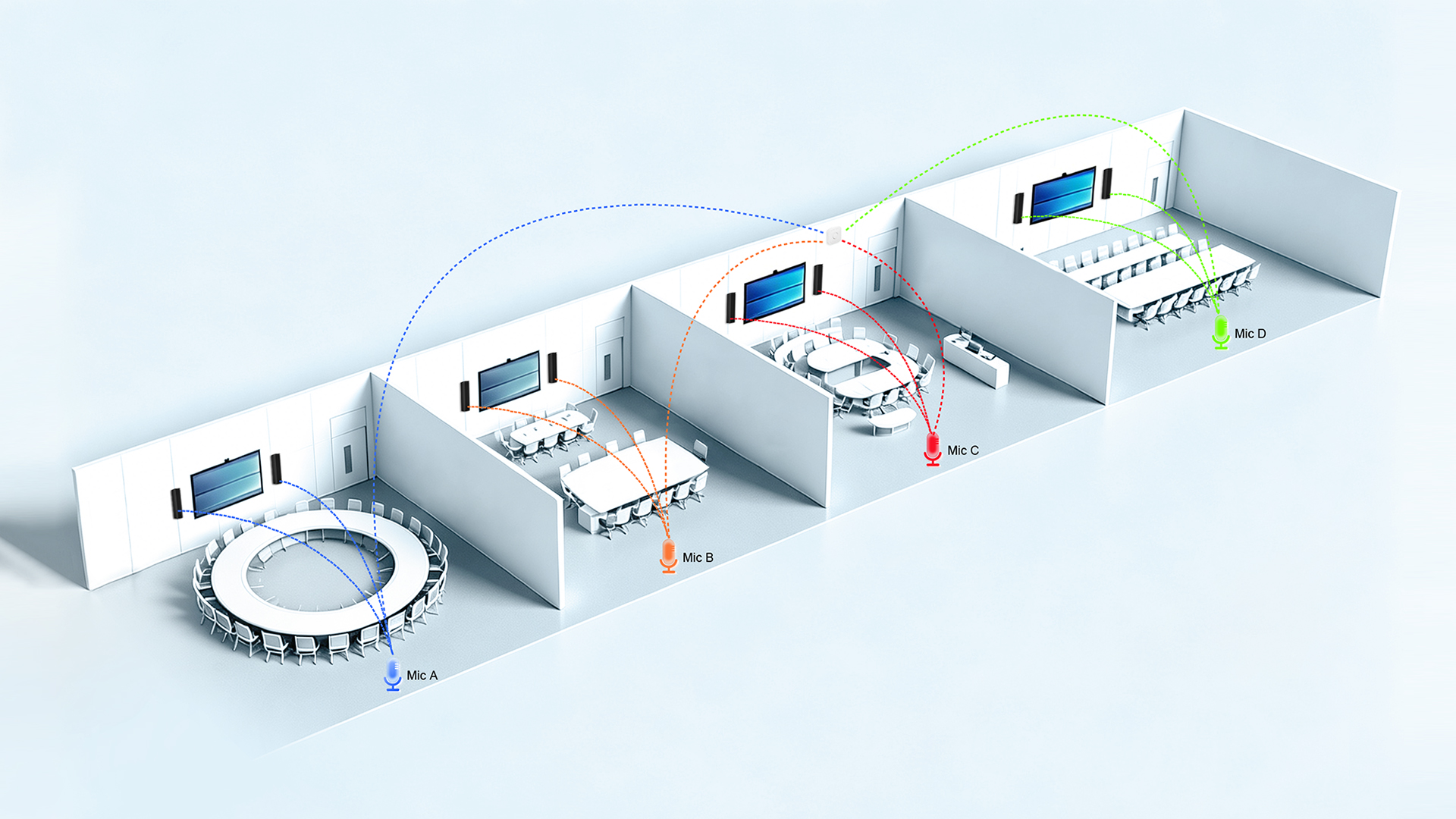
1.[Independent Matrix] Flexible Room Mode - Channel Grouping
Setting : A multi-functional hall, after being partitioned with movable partitions, is divided into four separate small meeting rooms: A, B, C, and D. If the system does not reorganize the aisles after the space is split, speeches from adjacent rooms will be incorrectly transmitted to the speakers (SPs) in this room, resulting in mixed meeting audio.
After spatial partitioning, the system groups the speakers via the host channel and physically binds them to the output speakers: the system regroups the speakers (SP) and microphones by room. Speakers in group A (SP A) are only bound to microphones in group A, outputting only sound from their own room, achieving precise local sound reinforcement. The microphone signals from groups A (SP A) are completely disconnected from those from groups B, C, and D at the underlying layer, with no overlap. Audio signals from outside this group cannot enter the output channel at all, fundamentally achieving independent operation of each room's channel.
| Microphone input source | Host port | Room A speaker (SP A) | Room B speaker (SP B) | C- room loudspeakers (SP C ) | D- room loudspeakers (SP D ) |
| Room A microphone (MIC A) | Access Port 1 | ✓ Local sound reinforcement (sound remains in room A) | ❌ Physical blocking (absolutely no sound leakage to other rooms ) | ❌ Physical blocking (absolutely no sound leakage to other rooms ) | ❌ Physical blocking (absolutely no sound leakage to other rooms ) |
| Microphone in Room B (MIC B) | Access Port 2 | ❌ Physical blocking (absolutely no sound leakage to other rooms ) | ✓ Local sound reinforcement (sound remains in room B) | ❌ Physical blocking (absolutely no sound leakage to other rooms ) | ❌ Physical blocking (absolutely no sound leakage to other rooms ) |
| C microphone (MIC C ) | Access Port 3 | ❌ Physical blocking (absolutely no sound leakage to other rooms ) | ❌ Physical blocking (absolutely no sound leakage to other rooms ) | ✓ Local amplification (sound remains in room C ) | ❌ Physical blocking (absolutely no sound leakage to other rooms ) |
| C microphone (MIC D ) | Access Port 4 | ❌ Physical blocking (absolutely no sound leakage to other rooms ) | ❌ Physical blocking (absolutely no sound leakage to other rooms ) | ❌ Physical blocking (absolutely no sound leakage to other rooms ) | ✓ Local sound reinforcement (sound remains in room D ) |
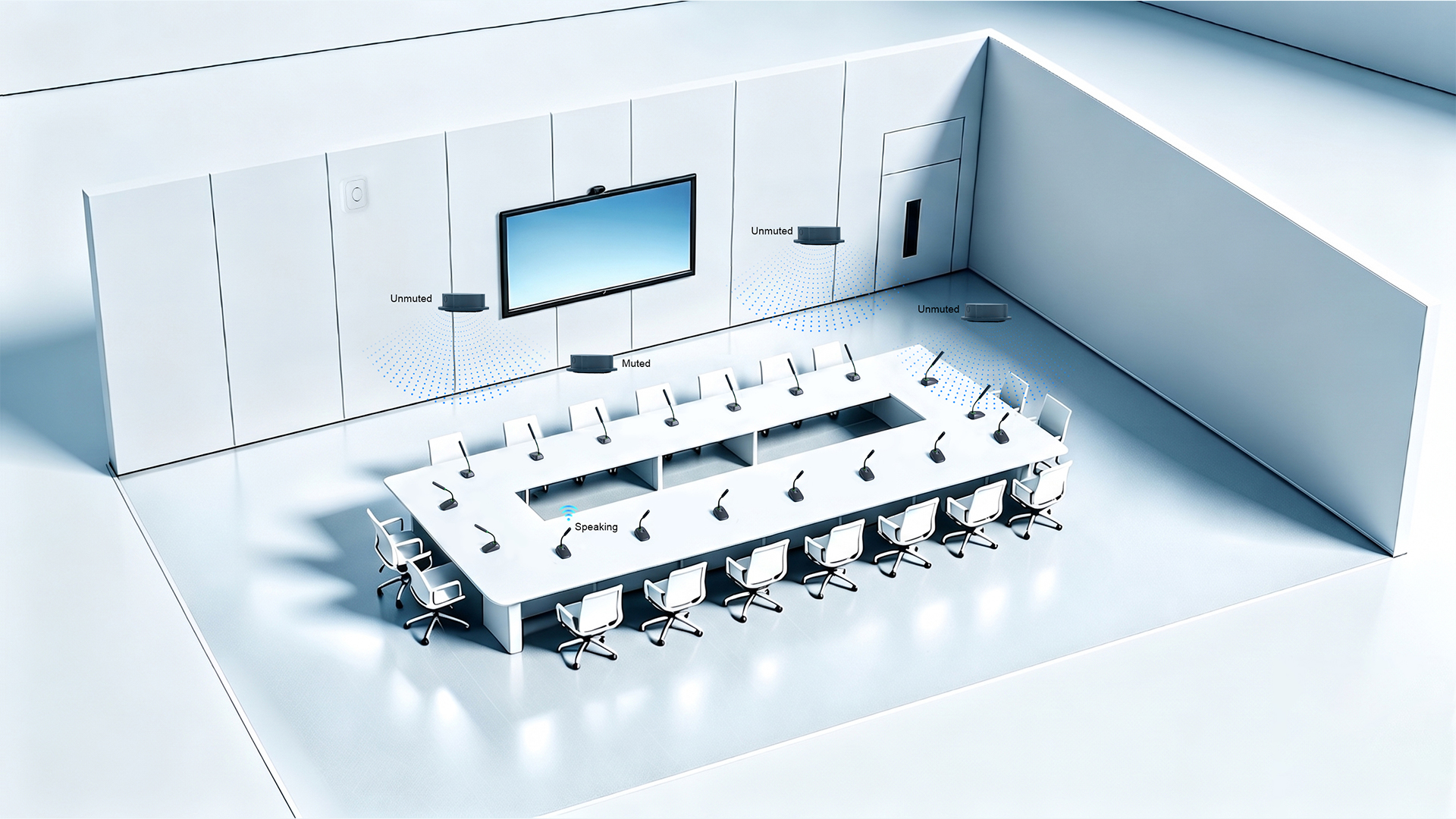
2. [Independent Matrix] Region Isolation Mode - Route Avoidance and Anti-Feedback Matrix
Setting : The desktop microphones (MIC 1-4) and four sets of speakers (SP 1-4) in the conference room are spatially aligned. The microphones are closest to the sound system directly above them. If the sound from microphone 1 comes from the nearest speaker, it will immediately re-enter the microphone, creating an infinitely amplified "positive feedback loop" that instantly triggers a piercing howl.
The system is based on a 4-input, 4-output independent channel matrix. By controlling the routing of each channel, it achieves "vertical avoidance and cross-sound reinforcement." For example, when microphone 1 (MIC 1) is speaking, speaker channel 1 (SP 1) is muted, and the speakers in that area do not produce sound. The system distributes the microphone signal to the other three output channels. The sound from microphone 1 is independently routed to speakers 2, 3, and 4. The sound only resonates at the far end, ensuring that all other seats in the venue can hear clearly, and the sound field is evenly distributed.
The four input and four output channels operate completely independently. Regardless of which representative is speaking, the nearest speaker will automatically "shut down," while the distant speakers will "speak" normally, perfectly solving the feedback problem of local sound reinforcement in fixed conference rooms.
Microphone physical location | Zone 1 speaker (SP 1) | 2-zone speaker (SP2) | 3-zone speaker (SP3) | 4 -zone speaker ( SP4 ) |
Microphone in Zone 1 (MIC 1) | ❌ Route avoidance | ✓ Cross-area projection | ✓ Cross-area projection | ✓ Cross-area projection |
Microphone 2 | ✓ Cross-area projection | ❌ Route avoidance | ✓ Cross-area projection | ✓ Cross-area projection |
3 microphone (MIC 3 ) | ✓ Cross-area projection | ✓ Cross-area projection | ❌ Route avoidance | ✓ Cross-area projection |
4- zone microphone (MIC 4 ) | ✓ Cross-area projection | ✓ Cross-area projection | ✓ Cross-area projection | ❌ Route avoidance |
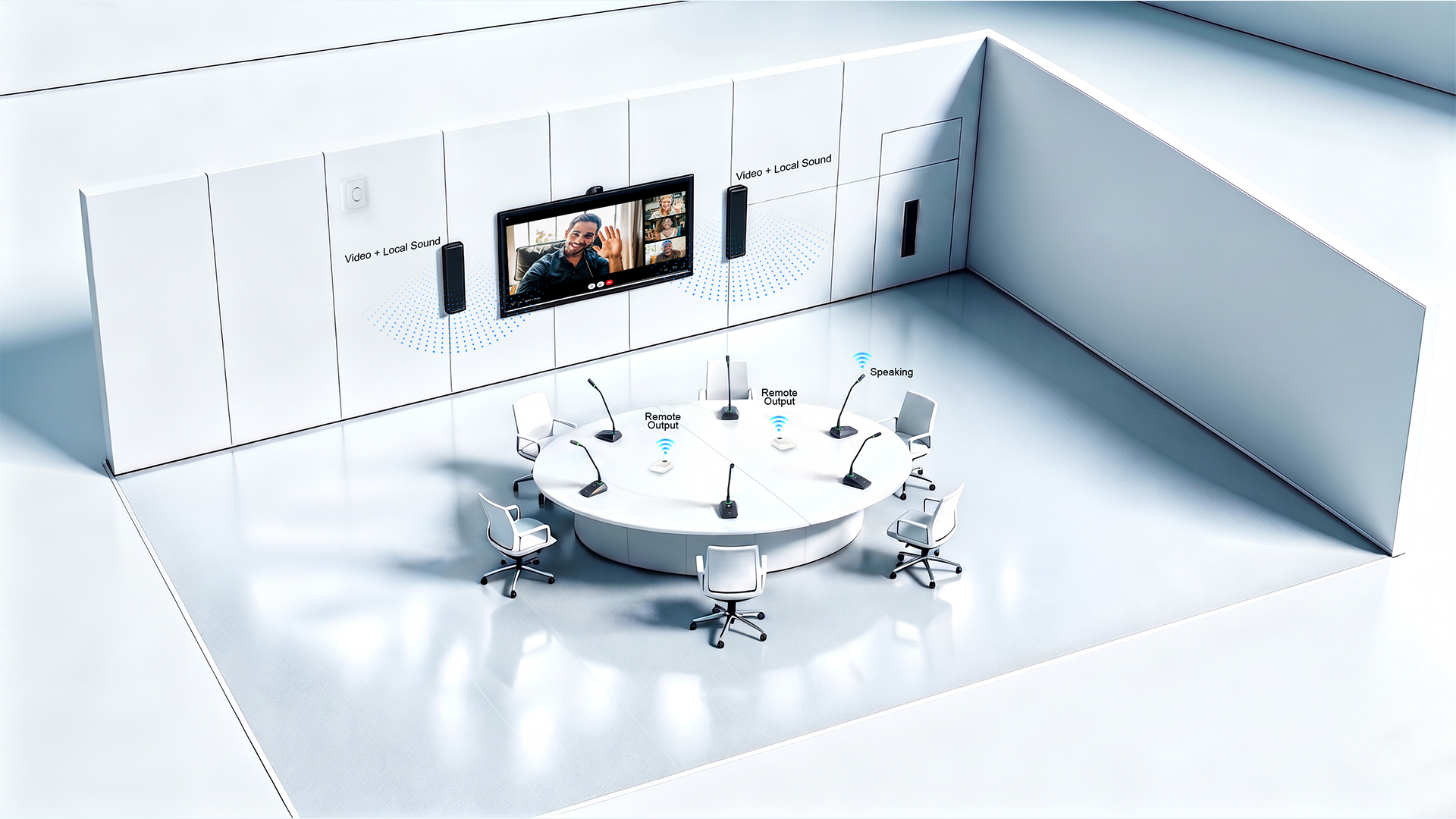
3.[Independent Matrix] Hybrid Conference Mode – Dual-Channel Output Suppresses Feedback
Setting: In a mixed conference, the desktop microphone is responsible for local sound reinforcement, while the interface microphone in the center of the round table is responsible for long-distance sound pickup and transmission to remote locations . Because the interface microphone is far from the speaker, its volume must be increased to ensure clear listening for those at a distance . If the system does not partition the audio and allows the interface microphone to participate in local sound reinforcement, its volume will instantly cause severe feedback in the room, which is impossible to resolve.
Technical Logic and Implementation: The host establishes two independent output partitions on the transmission port . The core purpose is to achieve "independent volume adjustment and cut off the source of howling":
Local microphones ➡️ Local sound reinforcement only Matrix control: The on-site microphone is normally connected to the [on-site room speaker] channel.
Underlying principle: Because the microphone is close to the person, the volume of the local sound reinforcement channel does not need to be turned up too high. In a safe low-volume environment, the system can easily suppress local feedback, making the sound crisp and stable on site.
Interface microphone ➡️ Only for remote sound pickup Matrix control: The interface microphone enables remote transmission, but it is completely cut off in the [Live Room Speaker] channel ( no local amplification).
Underlying principle: The purpose of the interface microphone is to pick up sound from a distance. Through dual-channel independent partitioning, the sound engineer can turn up the volume of this remote channel loud enough to ensure that online colleagues can hear it clearly; at the same time, because it is completely blocked from the local speakers, no matter how loud the remote speakers are, there will never be any feedback on the local device.
Remote video and audio input ➡️ Only input to local speakers Matrix control: When online colleagues' voices come in, they are only allowed to enter the [live room speaker] channel, so that the live room can hear the online speech clearly .
Audio input source | Local room loudspeakers | Remote video conferencing terminals |
Local microphone input | ✓ Local sound reinforcement | ❌No amplification
|
Interface microphone | ❌No local sound reinforcement | ✓ Remote transmission |
Remote video and audio input | ✓ Local amplification | ❌ Dual-channel isolation |
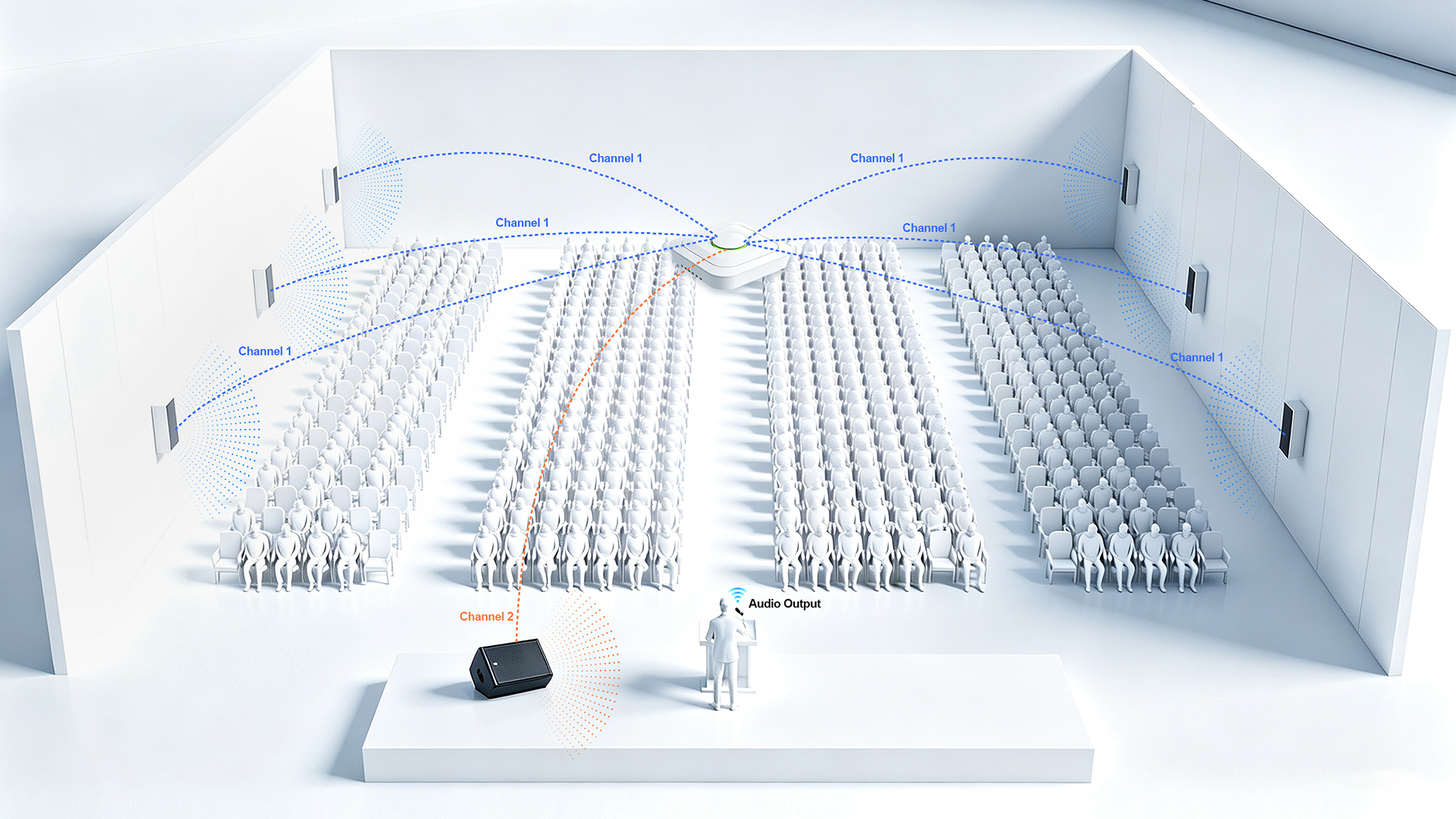
4. [Independent Matrix] Large-Scale Presentation Mode – Dual-Channel Low Latency to Prevent Discomfort
On-site environment: In large-scale speech scenarios, the on-site audio needs to undergo complex processing by DSP chips (such as feedback suppression, echo cancellation, dynamic equalization, etc.). These complex algorithms inevitably introduce system latency.
The problem: Acoustic research (Haas effect) shows that when the human ear hears itself speaking, if the sound delay is controlled within 30ms, the brain will automatically merge the sounds into one. However, if the total delay exceeds 30ms due to complex DSP processing (feedback suppression, equalization, etc.), the speaker will hear a noticeable strained accent, resulting in strong auditory discomfort.
Technical Logic and Implementation (Dual-Channel Partitioning and Low-Latency Monitor Principle)
The audio host uses two-channel partitioning to split the same microphone signal into two independent links with different latency:
Audience sound reinforcement channel ➡️ Channel-based matrix control: The speaker microphone signal is input normally, undergoes full DSP processing within the system , and is finally precisely projected to the audience speakers. Although the algorithm introduces a delay, it filters out all ambient noise and feedback risks, delivering the most perfect sound quality to the audience.
Dedicated Monitor for Speakers ➡️ Channel Two Matrix Control: The main unit directly copies and splits the microphone's raw signal to another independent output via channel partitioning, sending it directly to the speaker's dedicated monitor speaker.
Technical principle: This path bypasses any complex DSP algorithm output . Because it skips all computationally intensive steps, latency is compressed. The original sound emitted by the monitor speakers above the speaker's head perfectly triggers the Haas effect, allowing the speaker's brain to automatically blend the sound and completely eliminate any discomfort from accented notes.
Audio input source | Podium close-range loudspeaker | Audience seats long-distance loudspeakers |
microphone |
Output directly without any algorithm |
Output after DSP algorithm |