

Having worked in the conference systems industry for over a decade, I often hear this phrase: "This system works perfectly fine normally, and there have never been any problems." "Never having any problems" does not mean "the system is rock solid," but rather it may mean "the failure just hasn't happened yet." For stable operation of conference systems, building a complete protection mechanism is essential.
In modern business meetings, sound is key. When a CEO is speaking at a board meeting, during a crucial multinational video conference, or delivering a keynote address at a large forum, even a brief interruption in sound can result not only in a loss of information but also in an embarrassing and unprofessional corporate image. This is why audio source backup has become a standard configuration for reliable conference systems. A well-designed audio source backup can effectively avoid sudden audio failures in all kinds of meeting scenarios.
Today, as a technology sharer, I would like to have an in-depth discussion with you about an extremely critical yet often overlooked aspect of meeting systems—audio source backup architecture. When designing conference systems, designers always prioritize a stable audio source backup to guarantee continuous audio output. We will also talk about how to select a qualified network audio processor to match different backup solutions.
Many project managers without a technical background may wonder: Why spend double or even more money to buy the same equipment and run the same cables? Wouldn't a high-quality set of devices be enough to run stable conference systems? They rarely realize that a reliable network audio processor and complete audio source backup are the core of long-term stable operation.
The truth is: the occurrence of failure is a matter of probability, not a matter of whether it will happen.
Hardware aging: Microphone jacks, processor chips, switch ports—any of these components has a lifespan and may suddenly fail at any time. A faulty network audio processor will directly cut off audio transmission and affect the whole meeting.
Network fluctuations: Modern digital audio systems are highly dependent on networks. A simple network broadcast storm or the unauthorized access of a switch can cause Dante or AES67 audio packet loss or interruption. Such risks can be greatly reduced with proper audio source backup.
Human error: A cleaner accidentally broke the power cord of the core switch, or an IT staff member misconfigured the VLAN... These are all real-life scenarios that have caused immense distress for operators of conference systems.
Since malfunctions are unavoidable, all we can do is minimize their impact. That's the whole point of having a reliable audio source backup. Besides basic backup modes, hot backup is also widely adopted in high-grade equipment to enhance system resilience.
Below, I will start with the most basic simulated backup and show you AIMICIOT's four professional solutions built for conference systems. Each solution is paired with a dedicated network audio processor and can be combined with hot backup technology as needed. All our designs draw on years of experience in professional audio to deliver stable performance.
Solution 1: Dual-simulation dual-link backup
This is the most traditional and robust backup method. It is especially suitable for scenarios where there are concerns about digital network technology, or where extremely high reliability and zero dependence on audio networks are required. Its core idea is to establish two completely independent analog audio paths that do not intersect from beginning to end.
Solution topology diagram: conference systems
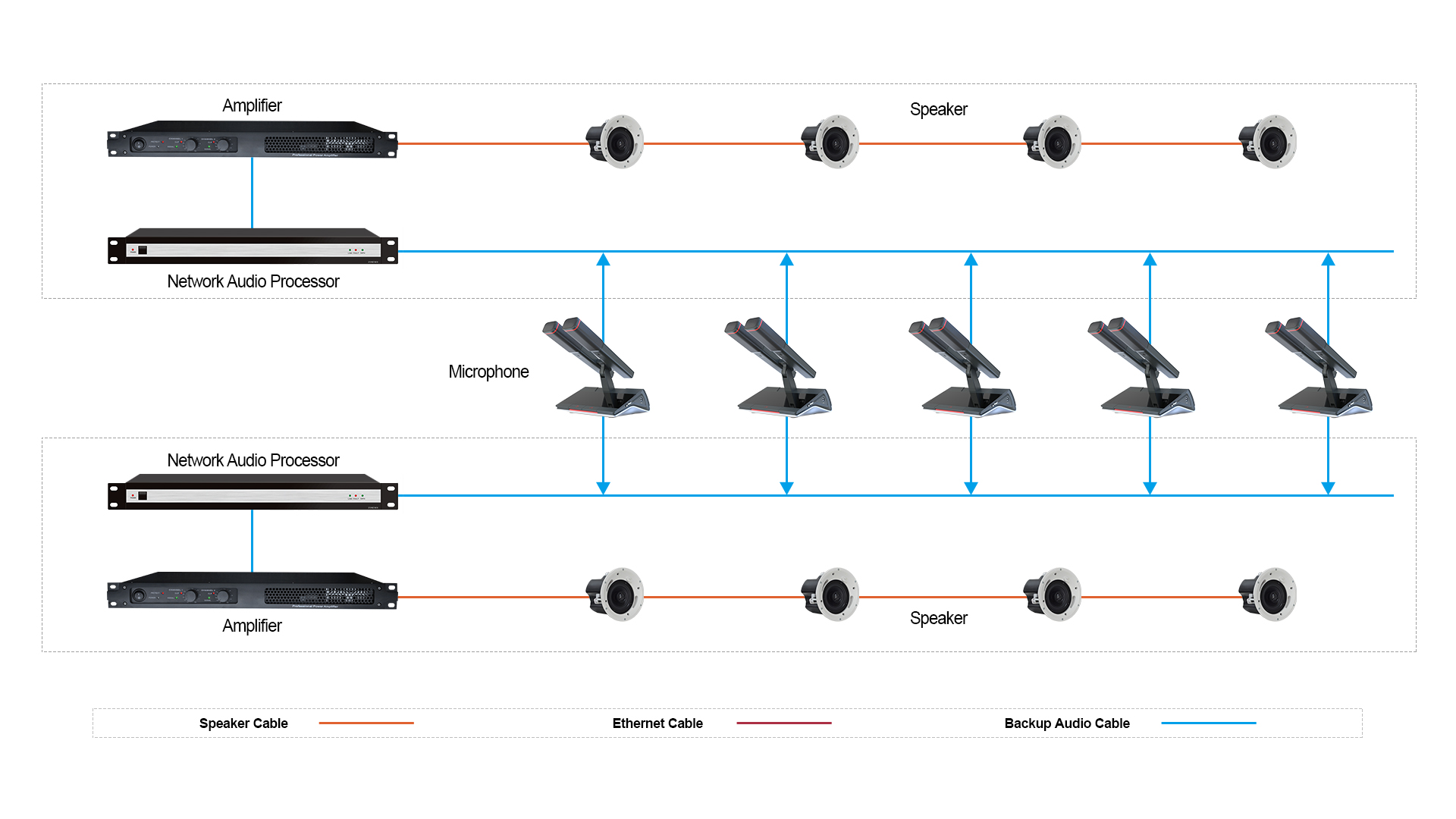
Explanation: As shown in the diagram above, the microphone has dual outputs, simultaneously inputting to two completely independent network audio processor units. This means that from the microphone itself to the network audio processor, amplifiers, and even the speaker paths, everything is physically separate – essentially two separate sets of conference systems. Even if one network audio processor completely loses power, the entire system below can still provide perfect sound. This basic audio source backup is easy to deploy and works well for conventional professional audio applications.
Advantages: Physical-level isolation, rock-solid stability, does not rely on any IT network technology, and troubleshooting is extremely simple.
Disadvantages: The number of devices and cabling costs are doubled, the system is bulky, and it lacks flexibility. It is not compatible with advanced hot backup functions.
Solution 2: AES67/Dante simulated dual-link backup
This solution works perfectly with AES67/Dante networks while maintaining the high reliability of analog links. It is suitable for upgrading and backing up existing digital audio systems, or for high-end rooms equipped with premium conference systems. It integrates mature professional audio technology and flexible network transmission.
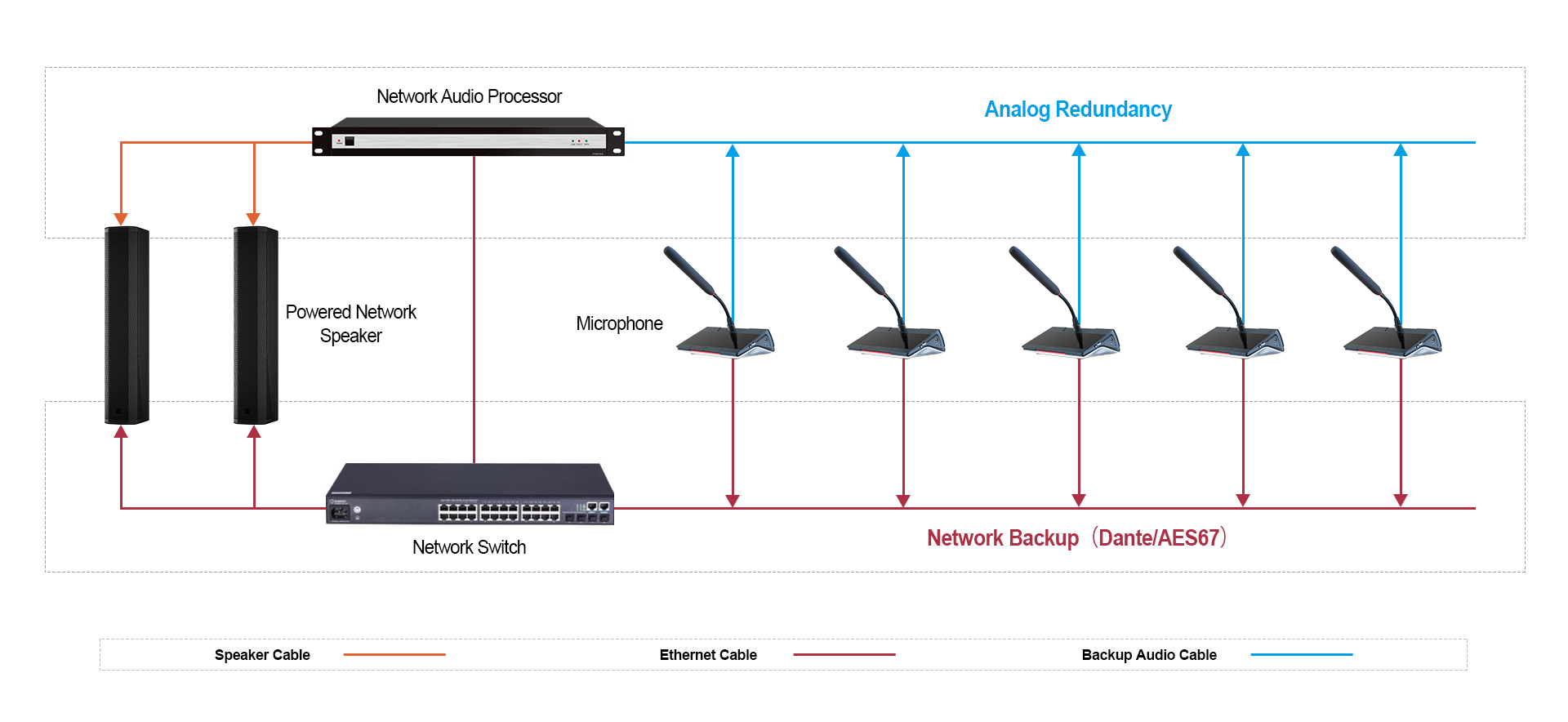
The core idea is that the microphone has both analog and digital (AES67/Dante) outputs, with the two signals entering the network audio processor separately. This dual-signal design strengthens the audio source backup capability of the whole system.
Solution topology diagram: audio source backup
Solution 3: Digital Conferencing System and Analog Backup
When conference systems become fully digital and networked, the cumbersome nature of all-analog cabling forces us to rethink our approach. Solution 3 leverages the advanced features of the host computer to establish a redundant ring network. It is suitable for modern, intelligent, high-end conference rooms with limited cabling space and strict requirements for professional audio quality.
The core idea is to use a host that supports ring network technology to form a physical loop. The matched network audio processor is optimized for ring network transmission, further boosting the efficiency of audio source backup.
Solution topology diagram: network audio processor
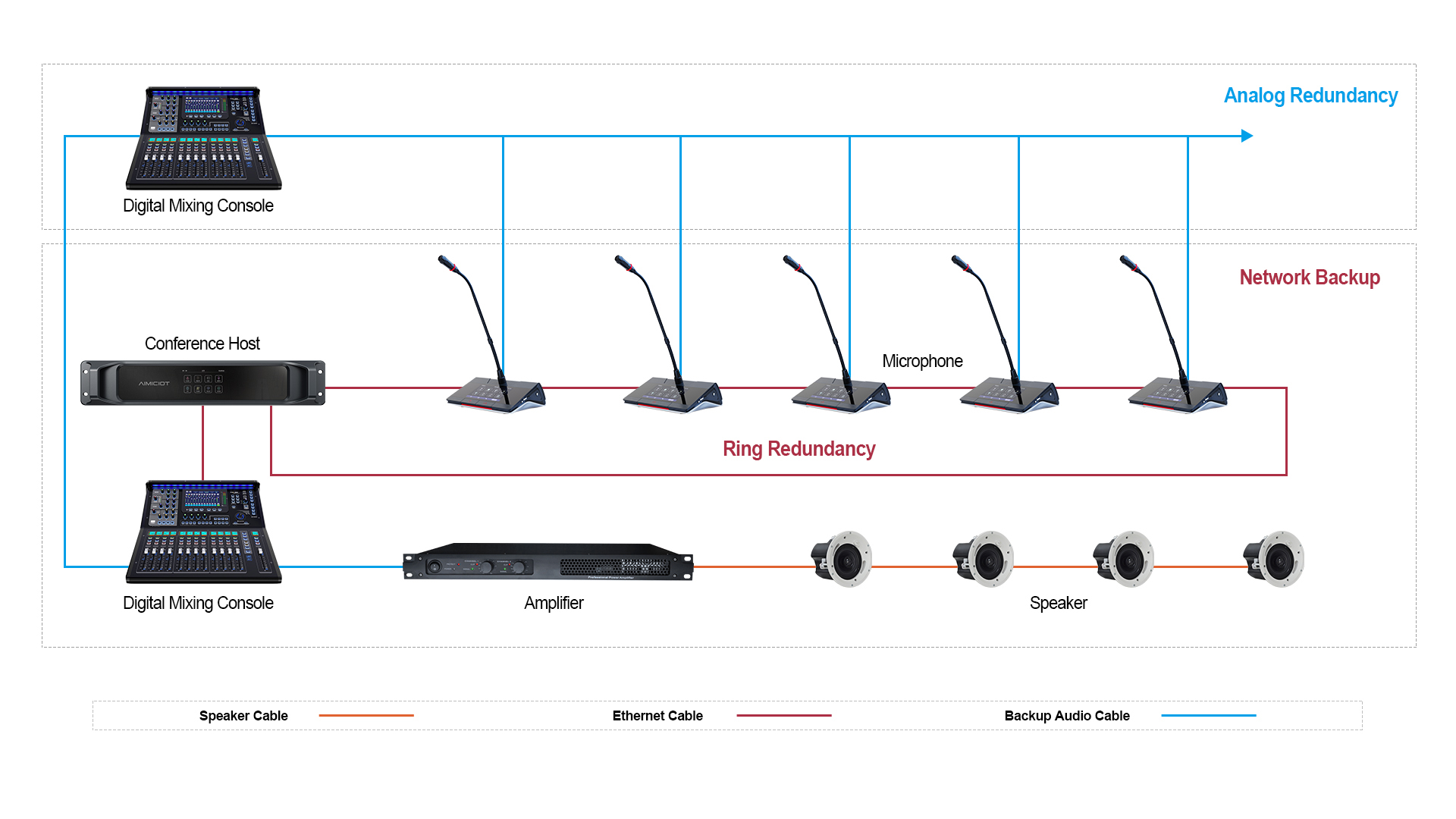 Interpretation: Topology diagram 3 illustrates an "elegant" daisy-chain digital solution. All microphones are connected to the same host, forming a physical network loop (Ring Redundancy). Simultaneously, each microphone retains an analog audio cable connected to the mixing console, forming a dual-layer audio source backup.
Under this architecture:
In traditional daisy-chain conference systems, if a network cable breaks in the middle, all the microphones behind it become silent. But this system uses a "closed loop" (ring network redundancy). The network cable starts from the host, connects all the microphones in series, and then loops back to the host. This means that even if any microphone node fails, the signal can still be routed back from the other end. The breakpoint self-heals in seconds, and those in the meeting won't even notice it.
Dual-source input: The input of the mixing console simultaneously receives digital audio and analog audio from the microphone. The intelligent network audio processor identifies and switches signals autonomously. This solution can work with basic hot backup to cope with sudden host exceptions.
Advantages: Makes full use of IT technology, highly digitalized, with minimal cabling, while retaining physical backup, and extremely flexible. It is a cost-efficient choice for modern professional audio setups.
Disadvantages: It places extremely high demands on the configuration of the network switch, and this solution cannot be used if the core network audio processor itself fails.
Solution 4: Dual-machine hot backup and multiple backups
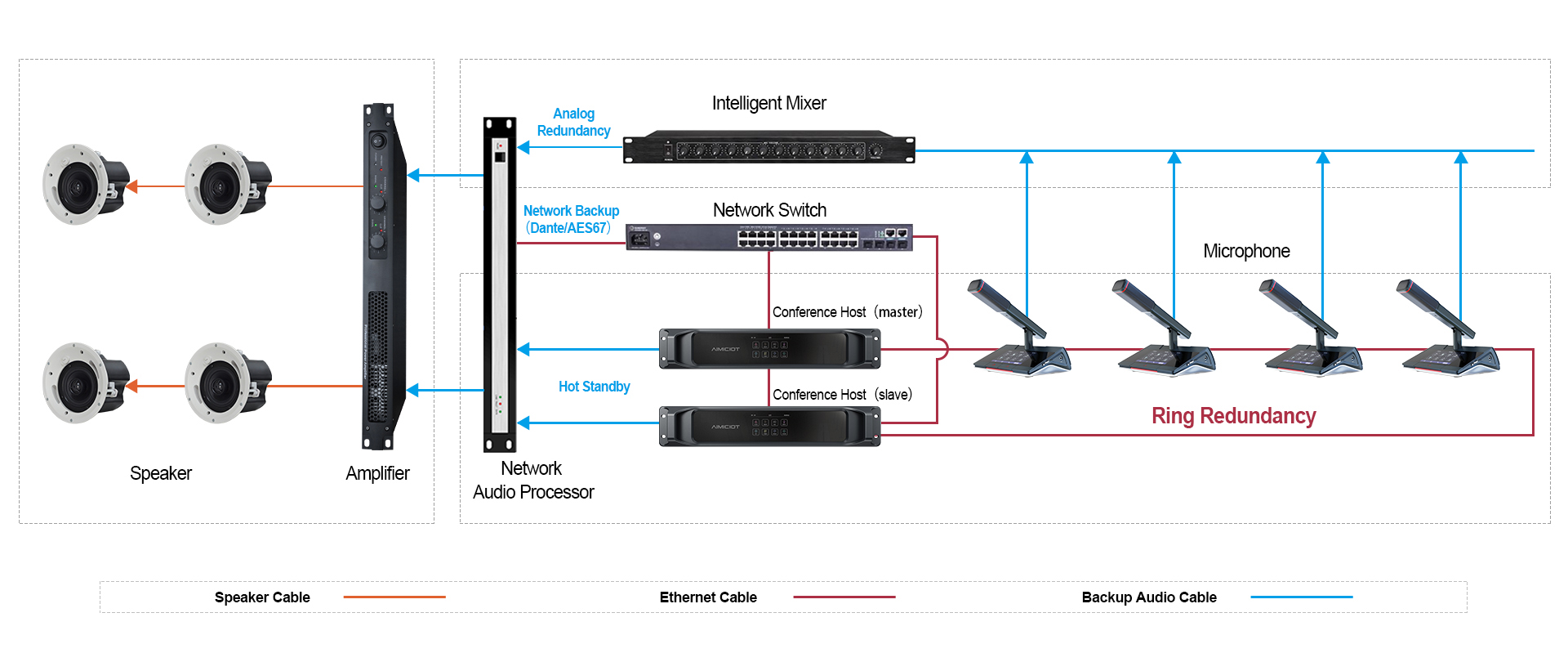
Main network digital link path: Microphone - Master conference host - Network switch - network audio processor - Power amplifier - Speaker.
Master-slave "dual-machine hot standby" link path: Master host (master) interconnects with slave host (slave) - network audio processor.
Pure physical "analog backup " link path: Microphone analog output - Intelligent Mixer - network audio processor.
How to choose?
Looking forward to seeing you in Bangkok!
Exhibition Guide
Exhibition Name: InfoComm Asia 2026
Booth number: H52
Exhibition Dates: July 15-17, 2026
Exhibition Venue: Queen Sirikit National Convention Centre (QSNCC), Bangkok